
A Complete Guide to SPIN Selling & How It Works
 April 9, 2025
 8 min read





Table Of Content
- What is SPIN Selling?
- Key Steps In The SPIN Selling Process
- Tips For Spin Technique
- 4 Stages of SPIN Model
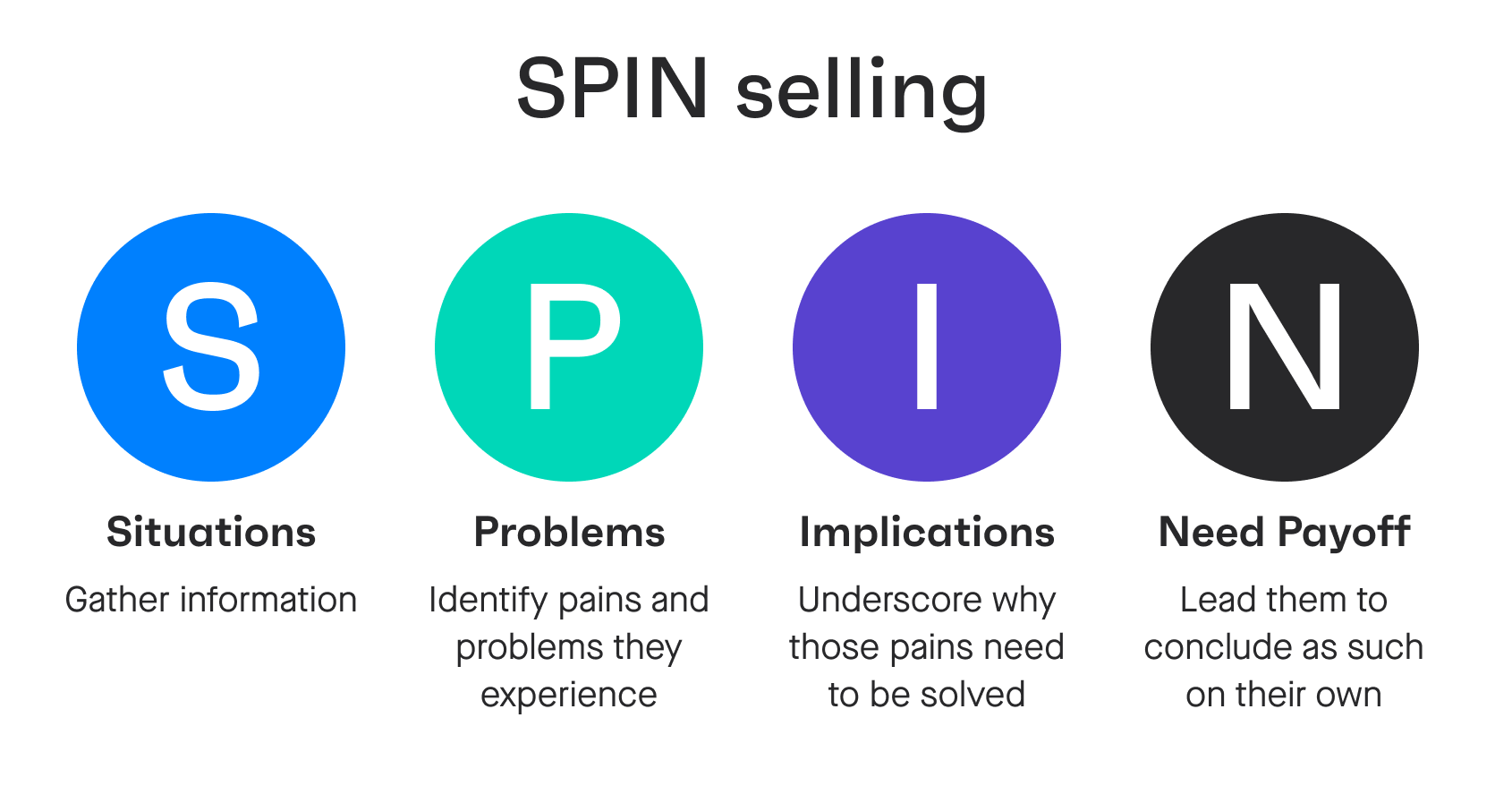
SPIN Selling is a powerful consultative sales approach developed by Neil Rackham. It helps sales professionals build trust and uncover the needs of customers through a structured questioning technique. The acronym SPIN stands for Situation, Problem, Implication, and Need-Payoff—four stages that guide sales conversations from understanding the client's background to presenting tailored solutions. Instead of aggressive selling, this approach relies on listening and diagnosing the pain points of the customer before offering the product or service.
The methodology of SPIN Selling gives salespeople the ability to engage in meaningful, insight-driven discussions that show value, not price. It is particularly effective in complex B2B sales environments where purchasing decisions require multiple stakeholders. Professionals can master SPIN Selling to enhance their questioning skills, gain more credibility, and develop long-term customer relationships that result in sustainable business growth. In this blog, we will learn the meaning of spin selling, the steps involved and the overall spin selling methodology.
What is SPIN Selling?
Spin selling is based on the premise that there are four main types of questions that need to be asked to make a sale: situation, problem, implication, and need-payoff.Spin selling is based on the premise that there are four main types of questions that need to be asked to make a sale: situation, problem, implication, and need-payoff.
Key Steps In The SPIN Selling Process
There are four major steps involved in the spin selling process, which are as follows:
1. Situation
Enquiries about the situation allow you to gain an understanding of the present state of affairs for your potential customers or clients.
You know, examples build context and help you to perceive a prospect’s present environment:
- Tell me what you do for your company.
- I would like you to take us through a typical day of your work.
- How do you approach [use case]?
- Could you please tell me about the processes?
- What tools are currently in use?
- Why spend money on these tools?
- What is your assessment of the tool?
- How frequently are they used?
- Who is responsible for [use case]?
- What percentage of your budget does [issue] represent? What is the most important factor for you this year? Why is this important to your business?
- Who owns the strategy for [priority]?
2. Problem
Problem questions help you identify your prospect’s pain points.
These questions could help to uncover very specific issues:
- How important is [priority] for your business?
- What challenges do you foresee?
- What is your biggest daily challenge?
- How easily are you able to make headway against [priority]?
- Why does this method work/not work for you?
- Is there an occasion where your present course of action on [priority] fails?
- What happens if you are not successful with [priority]?
- In a perfect world, what would your approach look like?
- Do you think a solution is possible for [problem]?
- What’s stopping you from solving it?
Add wonders to questionings to the spin full form
3. Implication
Implication questions help your prospect understand the consequences of not solving their problem. What will happen if they don’t take action?
Below are some examples that highlight the effects of the problems:
*Clari
4. Need-payoff
Need-payoff questions demonstrate the value of solving a problem and encourage collaboration. These questions explore how solving the problem will benefit the business and what results can be expected.
The following are examples that could help in making a purchasing decision:
- By what means would you do [approach] it differently?
- How would [solution] make it easier to achieve [priority]?
- Would your team derive value from [solution]?
- In what way does resolving the [problem] assist you?
- What would solving for [priority] do for your business?
- Has the business ever missed a KPI owing to this current approach?
- What are the costs of this current approach?
- How much time does the current approach take?
- If you didn’t have to spend these resources on [problems], how would you allocate them differently?
- What objective would you want to achieve that you currently can’t because of [problem]?
- What impact does [problem] have on your work?
- What impact does [problem] have on your team’s work?
- What impact does [problem] have on your customers’ experience?
- Would solving [problem] take you forward in your career?
Tips For Spin Technique
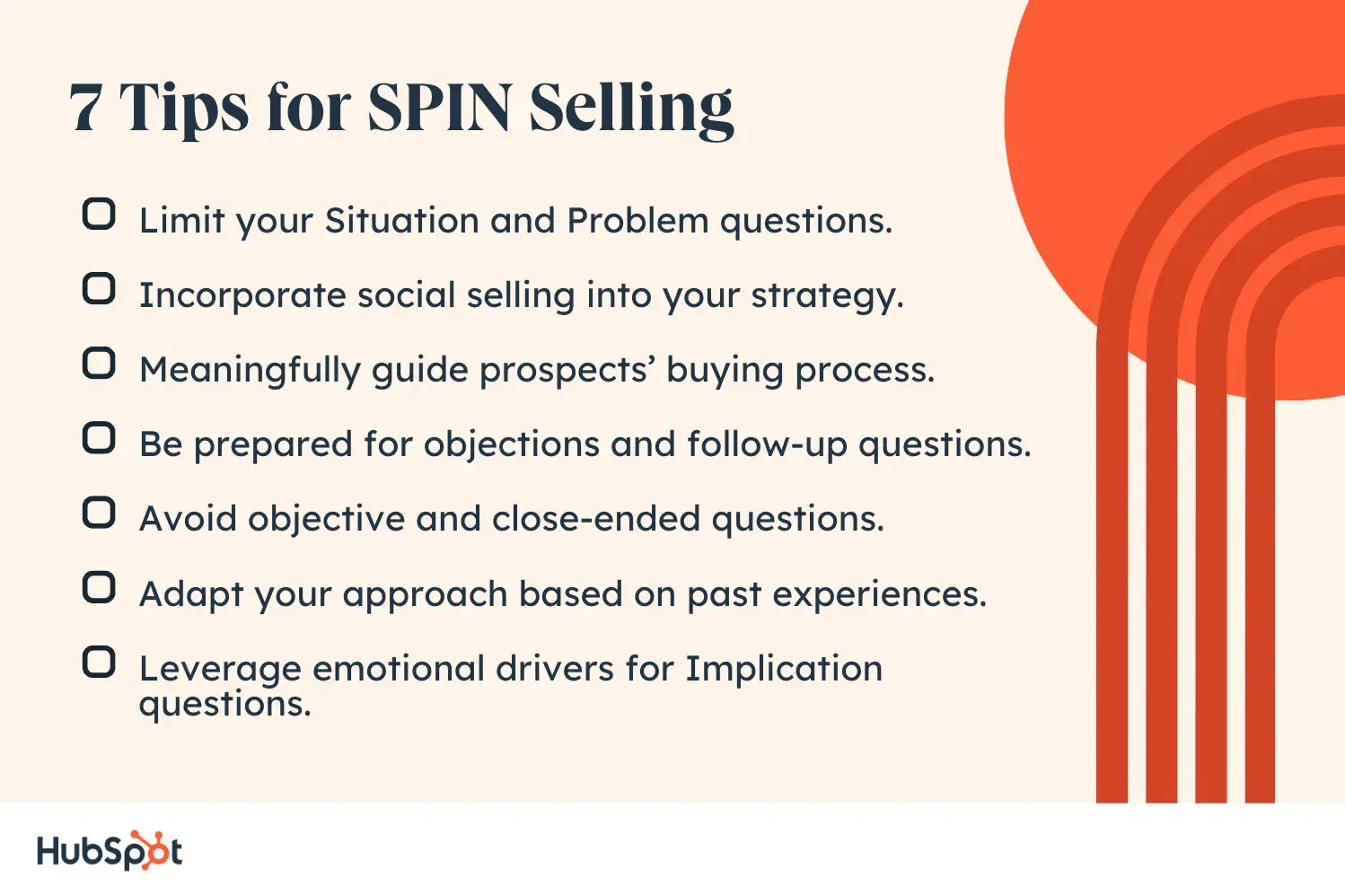
You can SPIN a sales call in a thousand ways; however, there are some universally accepted best practices to get them right, regardless of the end questions you ask.
1. Ask Purposeful Questions
However, if you ask open-ended questions, they should stimulate a more detailed answer to avoid getting simple “yes” or “no” answers. Actively listen to the buyer and validate their responses to maintain ongoing dialogue, and don’t overwhelm them with an abundance of questions at a time. Never ask questions just for the sake of asking.
2. Guide The Buying Process
Gaining the trust of every buyer with whom you are going to work involves anticipating their needs. Each person’s case is going to require a customized approach and a different stage in the buying cycle, along with relevant content, case studies, data, and support that can help the decision or commitment to next steps.
3. Leverage Social Selling
Leverage social media to find leads and build or maintain relationships with potential clients. Contact them via LinkedIn; disseminate materials that would be of interest to them; and gain intelligence regarding their image, industry trends, or purchase activities. Do this before the first sale interaction.
4. Make the Most of Technology
Use technology to simplify and enhance your sales processes. Manage customer data and interactions through a CRM system, use analytics tools to track sales performance, sales enablement platforms and playbooks for engaging prospects, and finally, virtual meeting platforms for enabling remote integration.
*Hubspot
5. Handle Objections and Follow-up
Listen to bids carefully, clarify misunderstandings, and offer solutions to the prospect’s objectives. Arm yourself with compelling arguments to counter potential objections, such as those related to price and time investment. Adhere to follow-up without fail.
6. Master the SPIN Selling Skills
SPIN selling calls for very much the basic sales ability besides being able to ask the right questions. This requires practice and true commitment to master consultative selling by following these four golden rules:
- Focus solely on one skill: to master complex skills, practice one aspect at a time, achieve mastery, and then proceed.
- Select calls that are less risky for practicing; practice makes perfect, but some opportunities are not worth it.
- Take a low-stakes practice setting where you can experiment and hone your skills without jeopardising a sale.
- Use the behaviour frequently; the more you do it, the more instinctive it becomes. In the course of time, your performance quality improves.
- Try it, at least at a behavioural level; the first attempts are rarely flawless. This holds for SPIN sales. Try your chosen behaviour at least three times before judging its effectiveness.
4 Stages of SPIN Model
To close a sale, the SPIN model technique suggests that salespeople should go through four distinct stages:
1. Building Rappor
Sales representatives who can build rapport with their customers are more likely to be successful in making a sale. Selling a sales pitch right away might turn away a prospective client. This is why it is essential to open and build rapport with a potential customer. There are many ways to build rapport, but the following four tips are essential:
2. Be Genuine And Authentic
Your customers can tell if you’re being sincere, so it’s important to be genuine in your interactions. You don’t have to tell them everything, but be honest about your goals.
3. Listen More Than You Talk
Let your customers do most of the talking. By showing that you’re interested in what they have to say, you’ll build trust and credibility. You can also glean valuable information about their needs and wants, which will be helpful when trying to close the deal.
4. Find Common Ground
Look for things you have in common with your customer, whether it’s a shared interest or background. This will help create a connection between you and make them more receptive to your sales pitch.
After establishing rapport, it is time to move on to the next step.
Learn SPIN Selling With Professional Certificate Programme in Strategic Sales Management and New Age Marketing, IIM Kozhikode
In the current hypercompetitive business world, sales is one area that faces major challenges when it comes to converting prospective leads into paying customers. This is where the Professional Certificate Programme in Strategic Sales Management and New Age Marketing, offered by IIM Kozhikode, comes into play. This comprehensive course includes key concepts in marketing, strategy, sales, and leadership, including a dedicated segment on “spin selling”. The pedagogy is designed to create competent sales and marketing managers through lectures, discussions, case studies, and hands-on experience that drive the lessons home. Enrol in this IIM Kozhikode course today with Jaro Education and explore new opportunities in highly coveted positions such as sales manager, marketing executive, sales specialist, and more.
Fee Structure:
- Application Fee: INR 2,000/- + GST
- Total Programme Fee (Exclusive of Application fees): INR 2,40,000/- + GST
How Does Jaro Education Aid Your Career?
Courses that Jaro Education offers are all top-notch and in collaboration with reputed universities and institutions. The programme faculties are composed of eminent faculty members, industry experts, and thought leaders. With Jaro Education, you get the learning of theory, not only with the insights from real-world professionals who guide you with the “how-tos” of practical strategies but also with leadership and critical thinking skills.
Key Benefits:
- Industry-Leading Faculty: Learn from top academics and experienced professionals.
- Practical Insights: Attain real-world knowledge through case studies and industry interactions.
- Mentorship: Personalised guidance is provided for overcoming challenges and bringing you one step closer to your goals.
- More learning opportunities: Flexible learning to suit your schedule.
How does it boost your career?
- Self-Paced Learning: You can study at your leisure and rate without taking leave from your job.
- Hybrid Learning Options: Join your live online sessions or recorded lectures per your schedule.
- Flexibility: So you don’t need to move or travel, making it easy to fold necessary learning into your busy lifestyle.
Conclusion
SPIN Selling remains one of the most powerful and long-lasting models and frameworks in developing meaningful client relationships and driving favorable sales results. Using Situation, Problem, Implication, and Need-Payoff allows the selling professional to turn a conventional sales dialogue into a problem-solving session in cooperation with the buyer. The SPIN Selling methodology boosts not just communication and trust but also makes sure solutions fit as closely as possible with the real needs of the customer. In today’s competitive environment, mastery of SPIN Selling allows sales teams to move beyond transactional selling toward consultative selling-creating long-term partnerships and value that assures consistent business growth.
Frequently Asked Questions
The four questions of SPIN Selling are Situation, Problem, Implication and Need-Payoff, representing the stages that form the basis of the SPIN Selling methodology in addressing needs and offering impactful solutions.
Yes, SPIN Selling is an effective methodology that is applicable in many modern sales conversations by allowing for conversations that are centered on value. When sales practitioners understand what SPIN Selling is, it is more likely that they will be able to engage in a more strategic engagement with the client.
SPIN Selling is intended to be based on the commitment to solve customer issues versus selling a product. The SPIN Selling methodology allows sales professionals to establish trust, create different solutions to deliver, and increase success over time.








Find a Program made just for YOU
We'll help you find the right fit for your solution. Let's get you connected with the perfect solution.
Is Your Upskilling Effort worth it?
 ROI Calculator

Are Your Skills Meeting Job Demands?
Try our Skill Gap tool
Experience Lifelong Learning and Connect with Like-minded Professionals
Explore Jaro Connect

