Career Options in Ethical Hacking: Courses, Jobs & Skills
Cyberattacks have become more advanced and complex, pushing the barriers of organizations to strengthen their defense systems in today's digitally dependent world. As companies are moving their businesses online, the demand for ethical hackers has increased astronomically. Ethical hacking is not a niche area of operation; it is a very mainstream and high-growth profession that offers scope, global demand, and lucrative salaries. More students and working professionals are now considering career paths in cybersecurity, particularly those targeting ethical hacker jobs in reputed companies.
Ethical hacking encompasses authorized security testing, whereby professionals attempt to find vulnerabilities in systems before malicious hackers can. This proactive approach has made ethical hackers indispensable contributors to cyberdefense. Most professionals achieve that by mastering ethical hacking skills, which enable them to mimic the attack, uncover security flaws, and suggest remediation. Such skills are achieved through structured learning and real-world practice supported by quality ethical hacker courses, certificates, and hands-on labs.
Table Of Content
What is Ethical Hacking, and Why Is It a Top Career Choice?
Why Ethical Hacking is a High-Growth Career Path?
Industries Hiring Ethical Hackers
Salary Expectations in Ethical Hacking
How to Start Your Ethical Hacking Career
Final Thoughts
Frequently Asked Questions
What is Ethical Hacking, and Why Is It a Top Career Choice?
Unlike most other traditional IT roles, ethical hacking gives the thrilling feeling of overcoming obstacles in very complex challenges. Experts apply profound ethical hacking skills to analyze attack patterns, understand hacker psychology, and develop strategies on defense that help in securing sensitive data. This combination of creativity, analytical thinking, and high-demand expertise attracts thousands of learners to pursue ethical hacker courses every year.
Why Ethical Hacking is a High-Growth Career Path?
Professionals apply high-tech tools and techniques in the field, including vulnerability scanning, penetration testing, and malware analysis-all these necessitate good ethical hacking skills. These are usually gained through structured training modules in globally recognized courses in ethical hacking, professional certifications, and practical labs simulating real attack environments.
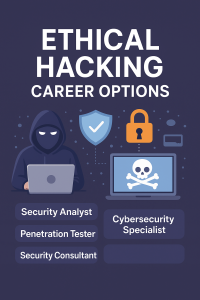
1. Penetration Tester
The job of a penetration tester is to simulate cyberattacks to evaluate the strength of an organization’s security system. Using their advanced ethical hacking competency, they try to locate vulnerabilities that malicious hackers might take advantage of. Many professionals start with foundational ethical hacker courses before progressing to advanced pentesting certifications.
2. Security Analyst
Security analysts study systems for anomalies, assess risks, and enhance security processes. Due to these job responsibilities, their role has become an essential part of the various ethical hacker jobs offered by enterprises and technology firms.
3. Cybersecurity Consultant
These consultants design secure network architectures for several clients. They use varied skills in ethical hacking, such as cryptography, network testing, and cloud-security assessment. Most of the consultants start their journeys with specialized courses in ethical hacking to garner credibility.
4. Vulnerability Assessment Specialist
This professional deals especially with finding system weaknesses and defects using automated and manual tools. Due to this, the demand for this profession is still growing across industries, giving rise to more ethical hacker jobs in top-end industries that are rewarding for skilled professionals.
5. Incident Responder
Incident Responders handle and control security breaches. Their skills in ethical hacking help pinpoint the very origin of an attack to reduce damage and avoid recurrence of such incidents in the future. In general, employers look for certified professionals from recognized ethical hacker courses.
6. Security Architect
They design secure systems, develop policies, and oversee teams that perform security engineering. This is a very senior role, almost exclusively filled by professionals with years of experience, as well as strong ethical hacking skills.
7. Malware Analyst
Malware analysts reverse-engineer harmful software to comprehend its mode of operation. This advanced specialization leads to niche ethical hacker jobs in cybersecurity labs and threat intelligence firms.
1. Networking Skills
Knowledge of routers, switches, firewalls, TCP/IP, DNS, and network protocols is essential. Most ethical hacking jobs demand higher-order networking skills.
2. Operating System Knowledge
Professionals should comprehend Linux, Windows, macOS, and mobile operating systems. These are key areas in which several ethical hacker courses, especially those related to penetration testing, have placed much emphasis.
3. Programming Skills
Ethical hackers often create scripts to automate tasks. Proficiency in Python, Bash, C++, and Java enhances an ethical hacker’s performance significantly.
4. Knowledge of Cybersecurity Tools
It uses a variety of tools, including but not limited to Nmap, Metasploit, Burp Suite, and Wireshark. Mastery of these can open the path to becoming an advanced ethical hacker.
5. Cryptography Skills
The major concepts that would help in solidifying the ethical hacking skills include encryption, hashing, digital signatures, and SSL.
6. Analytical Thinking
Ethical hackers need to think like an attacker. Many of the ethical hacker courses include training exercises for learners to interpret vulnerabilities creatively.
7. Knowledge in Cloud Security
As cloud adoption increases in companies, so does the demand for cloud-security skills. These skills will enable professionals to apply for more specialized jobs as ethical hackers all over the world.
1. Certified Ethical Hacker (CEH)
One of the most globally recognized courses, it comprises sessions on network scanning, vulnerability analysis, and finally, malware threats. In addition, CEH ensures high-level ethical hacker jobs in different industries.
2. Offensive Security Certified Professional (OSCP)
OSCP is regarded as having one of the most challenging practical examinations. It is highly focused on penetration testing and is considered an authority course on ethical hacking for professional practitioners at the advanced, senior level.
3. CompTIA Security+
Security+ provides basic training in cybersecurity and assists learners in strengthening the essential skills of ethical hacking. Security+ training is widely accepted for entry-level jobs as an ethical hacker.
4. eLearnSecurity Penetration Tester (eJPT)
eJPT is a practical certification that introduces learners to penetration testing. It is one of the best ethical hacker courses for beginners.
5. Google Cybersecurity Professional Certificate
This program equips learners with solid ethical hacking skills, including threat detection and SIEM tools, thus preparing them for early-career jobs as an ethical hacker in global companies.
6. Coursera, Udemy & EdX Ethical Hacking Bootcamps
Those online learning platforms are where many beginners start with building essential ethical hacking skills before progressing to advanced ethical hacker courses.
Industries Hiring Ethical Hackers
- IT and software companies
- Banking and financial services
- Defense & government organizations
- E-commerce and retail
- Medical technology
- Telecommunications
- Cloud service providers
These industries demand professionals with validated ethical hacking skills and demonstrated practical experience. Most organizations give preference to candidates who have obtained accredited ethical hacker courses prior to applying.
Salary Expectations in Ethical Hacking
The salary scale for skilled and accomplished professionals in ethical hacking is very competitive, especially if they have certifications from reputed ethical hacker courses that validate their capabilities.
How to Start Your Ethical Hacking Career
If you’re excited about the prospects in cybersecurity, here’s where you can start:
- Build basic IT and networking knowledge.
- Learn programming languages.
- Develop your ethical hacking skills by practicing with real tools.
- Sign up for entry-level ethical hacker courses that can train you in a systematic manner.
- Acquire experience through internships, bug bounty programs, or freelance projects.
- Apply for entry-level positions in ethical hacking and start your professional journey.
Anyone can build a rewarding ethical hacking career with continuous learning and a lot of patience.
Final Thoughts
Ethical hacking is dynamic and, therefore, a fast-growing field full of opportunities. It offers exciting work, intellectual challenges, along with the prospect of making a difference by protecting organizations from cyber threats. A professional with the right ethical hacking skill, hands-on experience, and carefully chosen courses of ethical hacking can secure high-paying ethical hacker jobs in global companies. Whether a student is at that point of choosing technology careers or a working professional seeking a career shift, ethical hacking is an effective future-proof career option.
Frequently Asked Questions
You could consider a variety of ethical hacker jobs: penetration tester, security analyst, incident responder, and others. Strong ethical hacking skills and recognized ethical hacker courses will open your entry to a broad domain of IT, finance, government, and cybersecurity firms.
CCNA is focused on networking, while CEH is best for students targeting the position of an ethical hacker and related cybersecurity jobs. If your goal is to build strong ethical hacking skills, CEH and related ethical hacker courses may offer more relevant training.


