
What is a CMA Course? – Eligibility, Syllabus, Salary
If you love finance, business strategy, and accounting, then the Certified Management Accountant (CMA) could be your ticket to a global career. In today's fast-paced, data-rich corporate world, businesses are on the hunt for people who can interpret data, analyse numbers and extract strategic insights for decision-making. This is where a Certified Management Accountant (CMA) comes in – a finance professional who knows why the numbers matter, and not just what the numbers are.
The CMA credential is globally recognized by the Institute of Management Accountants (IMA), USA. It signifies a rigorous standard for your professional career and designations that can transform your career. Whether you are aspiring to work in a multinational or consulting firm or to start or grow a business, having the CMA designation can provide endless opportunities.
In this blog, we will dig into everything you need to know about the CMA course, including eligibility, syllabus, duration, fees, salary and career growth potential.
Table Of Content
What is the CMA Course?
Understanding CMA Full Form and Its Importance
CMA Course Eligibility Criteria
CMA Course Duration
CMA USA Syllabus
5 Steps to Become a Professional CMA
Career Opportunities After CMA
CMA Salary in India
Why Choose CMA in 2026?
How Jaro Education Assists Your Success in Your CMA Journey
The Bottom Line
Frequently Asked Questions
What is the CMA Course?
The CMA course prepares accounting professionals to connect and align the financial implications to business strategy. The CMA is able to help organizations effectively manage costs, analyze and interpret data, and help organizations to achieve growth. The major distinction of the CMA qualification is the global recognition; in over 150 countries, professionals can earn the CMA qualification and practice across borders.
In addition to helping professionals earn the designation, the CMA course details connect you to a global network of over 140,000 accounting and finance professionals who are part of the IMA. The CMA is more than a designation, it is a symbol of financial and organizational leadership.
Understanding CMA Full Form and Its Importance
CMA recognizes professionals for their ability to convert data into insights and action plans. They know how to prepare, examine, and suggest action from financial statements and data-based information to improve decision-making. For that reason, CMAs are in high demand in operating roles, such as Financial Analyst, Finance Manager, Controller, and Chief Financial Officer (CFO).
In coming years, as the demand for finance professionals with analytics ability and management function skills continues to increase, CMA is becoming a mandatory certification for all enterprising accounting or business graduates who are seeking global roles.
CMA Course Eligibility Criteria
Here’s what you need to qualify:
| Criteria | Requirements |
| Educational Qualification | Must have completed Class 12 (with 50% marks) or hold a Bachelor’s degree from an accredited college/university. |
| Professional Experience | At least two continuous years of professional experience in management accounting or financial management. |
| Exam Score Requirement | Minimum 360 out of 500 in both parts of the CMA exam. |
It is important to mention that students may start preparing for the CMA course while still working on their degree, but they must be finished with their degree program before earning the certification. The work experience requirement can be fulfilled either before or within seven years of taking the exam, which allows for flexibility for both students and working professionals.
CMA Course Duration
In fact, there are many schools in India that offer the full CMA course, and they are designed to facilitate your learning journey. These courses allow students to master the curricular content around financial planning, performance management, decision-making, and strategic management – all in one year.
The CMA has two parts and is shorter than most other professional certifications. This shorter CMA course duration allows candidates to devote serious focus to the topics relevant to the CMA without spending years preparing.
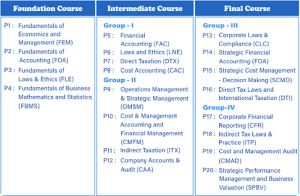
CMA USA Syllabus
*plutuseducation.com
The CMA course syllabus is formatted in such a way as to combine the sound technical knowledge required to be a successful professional with the practical application of that technical proficiency in a business environment. It covers two distinct parts in a building block approach:
Part 1: Financial Planning, Performance and Analytics
This part deals with the foundations of management accounting and financial reporting. Topics include:
- External Financial Reporting Decisions – Knowledge of financial statements and financial reporting standards.
- Planning, Budgeting, and Forecasting – Develop financial planning and forecasting as part of your organization’s overall strategy.
- Performance Management – Evaluation of organizational performance through KPI or variance reporting.
- Cost Management – Approaches to ongoing cost reduction and efficiency.
- Internal Control – Protecting the organization’s assets and ensuring compliance.
- Technology and Analytics – The ability to utilize data and analytics applications to leverage financial data to support key financial decisions.
Part 2: Strategic Financial Management
This part develops your advanced financial and strategy decision-making skills. The topics will consist of:
- Financial Statement Analysis – Understanding performance and profitability of companies.
- Corporate Finance – Management of capital structure(s), financing, and investment.
- Decision Analysis – Assessment of business scenarios using quantitative methods.
- Risk Management – Identification, assessment and mitigation of financial risks.
- Investment Decisions – Evaluation of long-term investments.
- Professional Ethics – Responsibility for maintaining integrity and ethical standards in the financial profession.
Instructions for each part include 100 multiple-choice questions and 2 essay-type questions and the total time allowed for the exam of each part would be 4 hours. Finally, the exam is not about mastering but rather an opportunity to apply concepts and solve actual business problems.
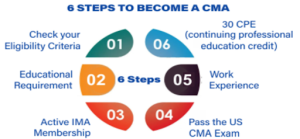
5 Steps to Become a Professional CMA
*plutuseducation.com
Pursuing the Certified Management Accountant designation can be done through a few practical steps. Here’s an overview of the process:
Step 1: Ensure You Are Eligible
Before starting, go through the eligibility requirements from the IMA. While a bachelor’s degree in commerce or finance is ideal, candidates in all disciplines can register. Applicants are encouraged to have a deep understanding of accounting and management principles. You will eventually want to validate that you meet the educational and professional requirements before you start the next step of becoming a CMA.
Step 2: Register with the Institute of Management Accountants (IMA)
Once you confirm you meet the eligibility requirements, you will want to then register with the IMA, becoming an official CMA candidate. You will have to pay for IMA membership fees, application fees and your examination fees. Once you register with the IMA, you will have access to study materials, educational resources, and networking opportunities in the profession.
Step 3: Study and Pass the CMA Exams
The CMA exam comprises two sections:
Part 1: Financial Planning, Performance and Analytics.
Part 2: Strategic Financial Management. Candidates often opt to take Part 1 first and Part 2 afterward.
You can be successful in the CMA exam if you follow a systematic study strategy, practice with exam-style tests, and sign up for one of the professional training organizations, which are usually Miles Education, Becker, or Wiley CMA. Sustaining regular practice and being conceptually pure is key to successfully completing either part on your first sitting.
Step 4: Obtain Relevant Work Experience
You will not be able to obtain your CMA certification unless you have had 2 years of relevant work experience to earn your certification status. You must have relevant work experience in areas such as financial analysis, management accounting, budgeting or auditing. You may obtain work experience prior to taking exams or within 7 years after you have passed the 2 exam sections.
Step 5: Become Certified, and Maintain CMA Status
Once you have passed both exam sections and earned your work experience, you are on your way to becoming a Certified Management Accountant! However, you must obtain CMA status, and you must also complete 30 hours of Continuing Professional Education (CPE) each year to maintain CMA status. CPE keeps CMAs afloat on financial advances, technology, and regulations each year.
Career Opportunities After CMA
- Financial Analyst / Business Analyst – Reviewing data, creating forecast models, and advising a case for investing.
- Cost Accountant / Budget Analyst – Improving budgets, reducing costs, and ensuring profitability.
- FP&A Manager (Financial Planning & Analysis) – Using financial data insights to improve a business.
- Internal Auditor / Risk Manager – Evaluating internal controls and financial risk.
- Corporate Controller / Finance Manager – Overseeing accounting operations and financial reporting in large organizations.
- Chief Financial Officer (CFO) – Leading an organization’s financial strategy to accelerate growth as the highest executive role in an organization.
The need for CMAs spans across industries, such as information technology, telecommunications, consulting, manufacturing, and banking. Obtaining your CMA qualification will yield a competitive advantage with multinational corporations and firms in India focused on receiving a world-class management accounting designation.
CMA Salary in India
| Job Title | Average Annual Salary (INR) |
| Cost Controller | ₹6.9 LPA |
| Finance Manager | ₹10.8 LPA |
| Chief Financial Officer (CFO) | ₹36.9 LPA |
| Senior Financial Analyst | ₹8.1 LPA |
| Accountant | ₹2.9 LPA |
| Certified Management Accountant | ₹5.0 LPA |
| Cost Accountant | ₹7.0 LPA |
| Financial Controller | ₹24.3 LPA |
| Internal Auditor | ₹5.8 LPA |
| Finance Analyst | ₹5.4 LPA |
The average CMA salaries in India are as follows:
Fresh CMA professionals are likely to start with salaries in the range of ₹4–6 LPA and with 5–8 years’ experience, can obtain salaries in the range of ₹15–25 LPA and above, depending on the employer and job title.
As a whole, the highest salaries today in India can be found with IT, ITeS, consulting, and telecom companies for CMA professionals.
Why Choose CMA in 2026?
- Globally Recognized: CMA is an internationally recognized certification, which means it is valued by employers around the world.
- Quick Route: You can complete your CMA in significantly less time than other professional programs.
- Earning Potential: CMAs earn up to 50% more than their counterparts who are not certified.
- Career Mobility: CMA can qualify you to move into leadership roles in finance and management.
- Skill Development: CMA develops strong analytical, strategic, and managerial decision-making abilities.
How Jaro Education Assists Your Success in Your CMA Journey
Jaro Education supports CMA aspirants with expert career guidance, personalized counselling, and structured learning to help you prepare confidently for both exam parts. Our mentors simplify complex CMA concepts, provide study strategies, and offer continuous academic assistance. With mock tests, doubt-clearing, and focused learning plans, we ensure you stay on track.
We also help you with resume building, interview preparation, and career direction, enabling you to explore top opportunities in finance, FP&A, and global corporate roles.Trust us as a complete learning partner, guiding you from preparation to career growth.
The Bottom Line
Overall, the CMA course is one of the best career investments you could make in education in finance and management. Not only is the CMA credential recognized globally, but the curriculum also prepares you for successful employment, and you are likely to earn a good salary. The CMA will distinguish you as a strategic financial professional and prepare you for leadership roles.
Whether you are a student or working professional, the CMA credential can provide you with global access, propel your career forward, and grant you membership in a preeminent association of finance leaders that is shaping the future of business.
Frequently Asked Questions


