Concepts of Binary, Octal, and Hexadecimal Number Systems in Digital Logic
Table Of Content
How Does the Binary Number System Work?
Unravelling the Octal Number System
What Does a Hexadecimal Number System Mean?
Correlation Between Binary, Octal, and Hexadecimal Systems
Applications of Number Systems in Digital Logic
Final Words
Frequently Asked Questions
How Does the Binary Number System Work?
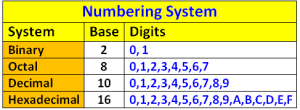
If you need to name the foundation of the number system in digital computation, it is the binary number system. By leveraging only two symbols, 0 and 1, the binary system represents the principle of binary logic. It is one of the best languages to represent and manipulate digital data.
The binary number system primarily operates on a base of 2. It signifies that each digit’s value is a power of 2. The digit at the rightmost position has the least significance. On the other hand, the digit on the extreme left is the most significant. For instance, 1010 is the binary number that represents the sum of 24 (16) and 21 (2), which is equal to the decimal value 18.
One of the prime advantages of the binary number system is its direct correspondence to the binary logic behind it, as used in digital electronics. In binary logic, signals are represented by two states, on and off or true and false. These align perfectly with the binary digits 1 and 0. This alignment allows electronic circuits to perform logical operations, like AND, OR, and NOT, using simple switches called transistors, which can be either on or off.
Unravelling the Octal Number System
The octal number system can be called the bridge that mends the gap between the decimal and binary number systems. It offers a convenient shorthand for representing binary data. It has a base of 8 and digits ranging from 0 to 7. It provides a compact way to express binary values.
This system operates on the principle that each digit will represent a group of three binary digits. These groups are termed bits. By condensing three binary digits into a single octal digit, octal numbers offer a concise representation while maintaining the integrity of the binary information.
Octal has immense utility in computer programming and digital circuit design. When dealing with large binary values, expressing them in octal form simplifies readability and reduces the length of numerical representations.
What Does a Hexadecimal Number System Mean?
Like binary and octal number systems, the hexadecimal number system is another convenient way to represent and manipulate binary data. It has a base of 16 and digits between 0 and 9, plus letters from A to F. This is a more concise format than the octal number system.
The hexadecimal number system is valuable when working with binary values of large size. Hexadecimal does not have the problem associated with binary and octal number systems with representations. Both binary and octal representations tend to become lengthy soon, which can be avoided with a hexadecimal system.
The hexadecimal number system plays a significant role in programming and debugging. Memory dumps and machine code instructions are commonly represented in hexadecimal. This facilitates the analysis and identification of specific patterns or issues within a programme. It also simplifies bitwise operations and binary arithmetic, making it an essential tool for programmers.
Correlation Between Binary, Octal, and Hexadecimal Systems
The binary, octal, decimal, and hexadecimal number systems are tightly related since they constitute the very basics of digital computation and logic. The binary number system, which uses only two digits, 0 and 1, is the basis of all digital operations. The decimal number system, used by humans in day-to-day calculations, can easily be converted to binary for processing by computers. In the same way, octal systems (base 8) and hexadecimal systems (base 16) are shortened forms of binary representation, in which every 3 binary digits correspond to one octal digit and every 4 correspond to one hexadecimal digit.
For example, the binary number 1101 is equivalent to 15 in decimal and D in hexadecimal. Conversion between these is necessary for easy programming, data storage, and circuit design. A good understanding of their interrelation helps digital engineers and programmers interpret machine-level data, optimize code, and ensure that digital communication is accurate across hardware and software layers.
Applications of Number Systems in Digital Logic
In digital electronics, number systems play a key role in data processing, storage, and representation. The binary system is the basis of operations in microprocessors, embedded systems, and logic circuits, whereby all signals are represented as 0s and 1s. It offers complete assurance in communication among the different hardware components. The decimal system is human-friendly and finds applications in user interfaces, display units, and numerical computations, whereby it allows users to interpret results in a format that is quite familiar to them.
Meanwhile, octal systems and hexadecimal numbers are widely applied in low-level hardware design, debugging, and digital communication. For instance, hexadecimal makes long binary strings much easier to represent in programming and memory addressing, while octal is often used in permissions and control systems. Understanding these systems thus allows digital engineers to bridge human and machine logic to ensure efficiency, precision, and error-free digital operations in modern computing environments.
Final Words
Having a grip on the binary, octal, and hexadecimal number system concepts is essential for a complete understanding of digital logic. Each of these systems has distinct properties and applications in the world of computation. By grasping each of these concepts, you can easily manipulate and convert data across various bases. Thus, enabling efficient programming, computation, and system design.
To gain insights into the number system and apply it to a real-world setup, enroll yourself for the Online BCA course offered by Manipal University Jaipur. The course promotes self-paced learning while facilitating students in hands-on labs. You can also check out this course offered in collaboration with Jaro Education.
Frequently Asked Questions


