
7 Must-Have Data Analyst Skills for a Successful Career in 2026
Have you ever thought why data analyst job roles have been one of the coolest job titles in India right now? Well, it's all because companies are no longer flying by the seat of their pants; they want hard numbers, clear insights and smarter decision-making. According to a recent report, India has a whopping 17.4% of all job postings worldwide looking for data analytics-related skills, and that share has increased by about 52% over the past five years. Clearly, this is not just hype but tangible movement.
And if you thought that was impressive, wait for this: industry commentators are already estimating that by 2026 India’s demand for data analytics and AI talent alone will surpass over one million professionals, which is driven by factors including everything from fintech to health-tech and e-commerce to government digital initiatives. So, if you’ve been planning to switch to a career in analytics, or if you want to improve your data analyst skills, now is the time to do it, as the wave is already in progress!
This comprehensive blog highlights what data analysis is and the 7 most important data analyst skills that every professional must have command of. Let’s get started.
Table Of Content
What Is Data Analysis?
Essential Skills Needed to Be a Data Analyst
How to Become a Data Analyst
The Bottom Line
Frequently Asked Questions
What Is Data Analysis?
For example, the product team may use data analytics powers to learn how customers engage with their products and discover what additional features customers would like to see implemented. In fact, the business can use this insight to make product enhancements to improve functionality and add additional features. This is a business example of data-driven decision-making in practice.
Essential Skills Needed to Be a Data Analyst
*ccslearningacademy.com
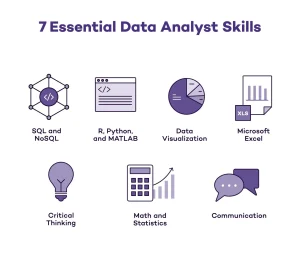
If you’re prepared to start a career in data analysis, then having the right set of skills is essential for success. Here’s the list of the top 7 skills required for a data analyst that any aspiring professional must have in their arsenal:
1. Analysis and Synthesis of Data
The most essential data analyst skills are the ability to analyse and synthesise data effectively. While analysis is about deconstructing complex data sets to find patterns, synthesis is the process of putting all the pieces together to provide actionable insights.
A great analyst does not just tell you what happened, they tell you what happened and how to fix it. For example, if you’re analysing the effectiveness of a marketing campaign, you could:
- Run statistical tests for hypothesis testing
- Identify trends in customer behaviours using efficient data visualisations
- Understand how the marketing campaign affected conversions or ROI
Once you have analysed the numbers, the next step is synthesis, or drawing meaningful conclusions. This involves answering some of the following questions for a business:
- What insights from these numbers can help with future strategy?
- Does this data reveal any hidden opportunities?
- What should be prioritised to maximise our impact?
2. Statistical Methods and Programming Languages
In 2026 and beyond, strong data analyst skills in programming and statistics will continue to be non-negotiable. Modern datasets are generally huge, fast-moving, and sometimes unstructured, which requires tools much beyond Excel.
Two of the most important programming languages used by analysts are Python and R.
- Python has commonly held many strengths, including flexibility, readability, and vast libraries such as Pandas, NumPy, and Matplotlib.
- Python excels at wrapping data into various containers, cleaning, analysis, as well as visualisation.
- R is a high-level language specifically developed for statistical computing.
- R will help you efficiently do advanced statistical modelling when taking contingent actions or further data exploration process.
These languages enable automated workflows, error reduction, and low-friction development when exploring or structuring data for analytics. It is also important data analyst skills on a resume as it lets employers know that you have a great understanding of SQL, as it continues to be the crux in interacting with and manipulating databases when querying.
3. Fundamental Knowledge of Mathematics and Statistics
A strong understanding of mathematics and statistics is the pillar of data analyst skills. While technology ensures that you simply work faster, it is mathematical thought that will allow you to work accurately with your data.
If you have an understanding of probability distributions, hypothesis testing, regression analysis, and correlation, you will feel more confident when evaluating patterns and making informed data-based predictions.
Furthermore, an understanding of the concepts related to statistics, especially, increases performance in a couple of ways:
- Avoid Analysis Bias: All conclusions are objective and based on facts. An ability to improve testing design will allow you to create valid A/B tests to improve marketing or optimize products.
- Forecast with Precision: will ensure that all predictive models will be statistically valid and reliable.
4. Data Management Expertise
Effective analysis starts with effective data management. No matter how well you know how to visualise or model data, your findings are only as solid as your data.
That’s why understanding the principles of data management is perhaps the most fundamental data analyst skill. Data management is all about:
- SQL: Arguably still the gold standard for managing and querying structured data.
- ETL processes (Extract, Transform, Load): Providing clean, organised, and analysis-ready data.
- Data governance and compliance: Knowledge of frameworks like GDPR and data privacy practices.
- Database design: Designing relational databases to perform and scale appropriately.
5. Data Visualisation Capabilities
Data visualisation is where your analytical work meets storytelling. It’s not enough to uncover insights; you need to present them in a way that’s visually appealing and easy to grasp. Thus, it is one of the most important data analyst skills in today’s world.
Modern organisations rely on visualisation tools like Tableau, Power BI, QlikView, and D3.js to communicate findings clearly. But what separates a great analyst from a good one is understanding visual storytelling, how to structure your visuals for impact.
Effective visualisation requires knowledge of:
- Chart selection: Choosing the right visual for the right data type.
- Colour theory and hierarchy: Using contrast and emphasis to draw attention.
- Narrative design: Guiding the viewer through your insights logically.
6. Project Management Proficiency
Technical knowledge is not sufficient in order to thrive as a data analyst; you should also have the capability to effectively manage projects. Thus, project management is another essential data analyst skill. Data analysis projects normally draw from a range of stakeholders, evolving priorities, and strict deadlines.
While data analysts most likely won’t become certified project managers, learning the basics of project management enables analysts to:
- Share findings with different teams in a clear and concise manner.
- Ensure that deliverables from a project iteration align with a business’s goals.
- Effectively manage resources and timelines.
- Adapt to changing priorities and requirements.
Think about whether you are tentatively working on an analytics project that pulls in data from multiple departments. Having a data analyst on the team who is equipped to manage the project as well as their analytical responsibilities allows that data analyst to work as a buffer between engineers, marketing teams, and management.
7. Machine Learning Basics
As machine learning (ML) has completely transformed agencies and companies, having a basic understanding of its principles is invaluable for data analysts skills. You do not need to become a data scientist, but knowing the basics will make you more competitive in your role.
Topics you can be thorough with:
- Supervised vs. Unsupervised learning
- Popular algorithms: Decision trees, k-means clustering, and linear regression.
- Model evaluation metrics: Precision, recall, F1-score, and ROC curves.
- Ethics: Bias, fairness, and transparency in AI models.
Note: The advantage of knowledge in machine learning for analysts is that it can make their own predictive models smarter and will have the added benefit of automating often tedious analysis for them. Rather than forecasting sales on a spreadsheet, you could develop a regression model that predicts sales based on past sales data.
How to Become a Data Analyst
*robertsoncollege.com
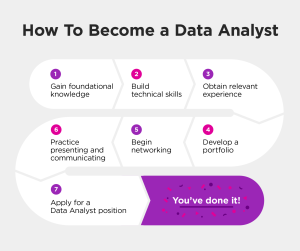
Now the question comes: how to be a data analyst? Well, here’s a step-by-step guide to help you kickstart your career as a data analyst:
- Establish a Solid Base:
Before delving into the analysis, familiarise yourself with the foundations of mathematics, statistics, and data analysis. These disciplines are critical components of analytical thinking and decision-making skills.
- Learn Essential Technical Tools:
It is a fact that if you are not keeping yourself updated with all the latest technical tools, you are falling behind. Thus, make yourself aware of the most common tools used in analysis, such as Excel, SQL, Python, and R. These tools are commonly used to clean, manipulate, and analyse data across multiple job industries.
- Work on Visualisation Techniques:
Visualisation is one of the most important parts of analysis. So, learn about the tools like Tableau, Power BI, or Google Data Studio, in which you can visually depict information in graphical formats easily and report insights to decision-makers effectively.
- Seek Hands-on Opportunities:
You will want to work on a project with real-world applications, pull and analyse open data, and/or participate in hackathons to apply your theoretical concepts and gain experience for your portfolio.
- Obtain Certifications or Degrees:
Register in a recognised online program or certification in Data Analytics, Computer Science or Business Analytics to prove your data analyst skills and improve your job prospects.
- Work on Your Soft Skills:
Soft skills are equally important as data analyst technical skills. So, make sure that you work on your communication, problem-solving and business knowledge so you can communicate the data in a way that further helps someone make strategic decisions.
- Learn with Jaro Education:
Explore programs offered online by Jaro Education in Analytics and Business Management by accredited universities. Get flexibility with your learning, expert support, and rely on career guidance to ensure your experience is productive as a professional data analyst.
The Bottom Line
Without a doubt, for a successful career as a Business Analyst, it is important to have the above-mentioned data analyst skills. Not only does it give you the ability to identify issues, but helps you to conclude solid logical reasoning.
Now, if you are curious about learning data analytics and science to be in front of fast-paced technological advancement, check out Jaro Education’s online certification programs. Our programs are designed with industry-standard curriculum that can help you be proficient in data analytics using techniques like visualisation and predictive modelling. Visit our website to explore our online courses and get access to complete Jaro Education Advantage.
Frequently Asked Questions
While communication is an essential skillset, it complements, not replaces, the data analyst technical skills. A data analyst with strong communication skills can better articulate their findings and collaborate with others.


