
Know about different ways to collect data for Data Science
If there is one saying that holds more truth today in the world of evolving data science, it is the saying "garbage in, garbage out." The quality and relevance of the data being fed into your models are directly related to the insight one can derive from them. Data collection methods, thus, present the very foundation of any successful data science effort. Without a strong strategy for gathering information, even the most sophisticated algorithms will struggle to produce meaningful results.
This blog post will serve as your comprehensive guide to understanding the various data collection and analysis techniques available to data scientists today. We'll explore what data collection is, why it's so important, and all the great benefits it provides, along with some key data collection tools that will make your life a whole lot easier.
Table Of Content
What is Data Collection?
The Importance of Effective Data Collection
Benefits of Strategic Data Collection
Key Data Collection Methods
Key Data Collection Tools
Conclusion
Frequently Asked Questions
What is Data Collection?
In essence, the process of data collection is systematic in nature, gathering and measuring information from various sources to answer research questions, test hypotheses, or predict future trends. This is the first step in any data-driven project, delivering the raw material that data scientists then transform into actionable intelligence. Accordingly, it involves identifying what data one needs, finding the best ways to collect such data, and proceeding with meticulous implementation of those methods.
Think of it as the investigative phase of any data science project. The detective would look for clues and gather them, so would a data scientist by collecting data points. These could be anything from a simple numerical value to complex textual documents, images, or even sensor readings. Because information is diverse, so are the means with which we capture this information: data collection tools and techniques.
The Importance of Effective Data Collection
Benefits of Strategic Data Collection
Secondly, it facilitates problem-solving. When faced with a challenge, comprehensive data can pinpoint the root cause of an issue, allowing for targeted and efficient solutions. For instance, when experiencing declining sales, gathering data on customer feedback, market trends, and competitor activities may give insights into the core reasons for such sales decline. This makes the data collection and analysis phase crucial for identifying actionable solutions.
Thirdly, data collection is a driver of innovation. Through systematic collection of data, understanding the needs of the market, customers’ preferences, and emerging technologies will drive companies to create new products or enhance their services. Insights from a well-implemented data collection tool may spark creativity and lead to breakthrough innovations.
It improves efficiency in that it monitors processes and performance through collected data, which helps the organization identify inefficiencies, bottlenecks, or areas that are in need of optimization. This leads to streamlined operations, reduced costs, and increased productivity. The bottom line can be directly affected by the implementation of effective data collection methods. Finally, strategic data collection allows for better risk management. By collecting data on potential risks, market volatility, and operational vulnerabilities, organizations can anticipate challenges and develop mitigation strategies that protect their assets and assure longevity. The capability of collecting and analyzing relevant data is a strong risk assessment mechanism.
Key Data Collection Methods
1. Surveys and Questionnaires
The most common methods of data collection for obtaining raw information directly from individuals are surveys and questionnaires, which include a series of questions that are specifically prepared to garner a particular response. These can be administered in several formats:
Online surveys are widely popular because they are cost-effective and reach wider groups. Tools like SurveyMonkey, Google Forms, and Qualtrics are excellent platforms for data collection in this regard.
Paper Surveys: Traditional method, normally used in specific settings or with populations that have low internet access.
These are questionnaires conducted over the phone, allowing direct interaction and clarification of questions. Telephone surveys
Mail Surveys: Mailed via U.S. mail, but generally yielding lower response rates.
Well-designed questions, which are clear, unbiased, and relevant, are the keys to successful surveys. They will enhance the quality of data collection and analysis.
2. Interviews
Interviews allow a far more in-depth approach than surveys and enable nuanced understanding of complex topics. This data collection method is direct, usually one-on-one, and involves an interviewer and a respondent.
Structured Interviews: The questions are standardized, and no deviation is allowed, similar to a verbal questionnaire, making comparisons easier.
Semi-structured Interviews: Standard list of questions core, but flexible in terms of sequence and probes according to the responses of the respondent.
Unstructured Interviews: These are more conversational, with general topics that guide the conversation; appropriate for exploratory research.
Interviews are most useful during research requiring qualitative information and exploring motivations or perceptions. Careful recording and transcription of interviews form a basis for subsequent data collection and analysis.
3. Observations
Observational methods of data collection involve observing directly and recording behaviors, events, or phenomena in their natural setting. This method is quite useful when studying behaviors that people might not accurately report in surveys or interviews.
Participant Observation: The researcher becomes part of the group or setting under observation.
Non-participant observation involves the researcher observing from a distance without direct involvement.
Structured Observation: Specific behaviors are recorded using either a checklist or a predeveloped coding scheme.
Unstructured observation: The observation is more open-ended, with the researcher noting down anything relevant.
Outwardly, observational data provides rich contextual information that can supplement other methods of data collection and analysis. This approach, of course, requires careful documentation.
4. Existing Data (Secondary Data)
There are occasions when existing data is still valuable and may be used in your data science projects. The data collection involved in this process is known as secondary data collection. The main advantage of this data collection approach is that it is less time-consuming and more resource efficient since someone else has already carried out the data gathering process. The following are examples of sources:
Public Databases: Publicly accessible data including the census data of government and open data portals.
Academic Research: Research works, journals, and dissertations.
Industry Reports: Market research reports and financial statements.
Internal Company Records: Operational logs, databases of customers, and movements of sales.
Social Media Data: Public posts, trends, and analysis of sentiments (in most cases it demands the use of specific tools for data collection and scraping which may be costly).
It is important to evaluate the reliability, relevance, and data collection methodology even if secondary data sources might be convenient. Such evaluation ensures the integrity of your data collection and analysis through this important step.
5. Experiments
Experiments are a strong method for data collection that is used to support the existence of cause-and-effect relationships. The process consists of changing one or more variables (independent variables) and then observing the change taking place in another variable (dependent variable) while controlling other factors.
Controlled Experiments: Are performed in a lab setting designed to greatly reduce the influence of external variables.
Field Experiments: Are conducted in an everyday situation thus providing higher ecological validity.
A/B Testing: This is the most common type of experiment in the field of data science where each version of an offering is shown to different user groups to conclude which one has better performance.
Experimental data is rated very highly because of the strong support it gives to theories. The planning of an experiment is a very significant stage in this particular data collection technique.
6. Internet of Things and Sensors for Data Collection
The exponential growth of IoT technology has resulted in the development of many different types of sensors, and therefore sensor data collection techniques have become a common method for collecting and using data. Sensors are found within a variety of different types of items, from smartwatches to industrial equipment, and provide continuous, real-time data relating to a large number of different measurements, including temperature, pressure, location, motion, etc.
Some of the different types of sensors:
Environmental – Weather station, Air Quality Monitor
Wearable Devices – Fitness tracker, Health Monitor
Industrial – Monitoring Performance of Equipment, Predictative Maintenance
Smart Home – Energy Use, Security
To support and maintain a continuous flow of sensor data, robust infrastructure will be required to store and process the data, as well as specialized data collection tools that provide real-time identifications of sensor data for analysis. This type of collection and analysis of sensor data will continue to increase significantly, exponentially.
7. Data Collection by Web Scraping
Web scraping is synonymous with collecting data or extracting data from the web using computers to do so. Data is typically considered public data to the extent that is available on the web, yet is not available in a format that would allow for easy and quick downloading of the data from the web.
Examples of data commonly collected using web scraping techniques include product data (including price, reviews, and product description) from E-commerce sites, trending topics and sentiment from news articles, and public profiles and hashtag trending from Social Media posts.
There are ethical considerations for those conducting web scraping, as well as terms of service on most websites that prohibit or restrict the use of web scraping. That said, specialized libraries, available in some programming languages such as Python (verbose examples include: BeautifulSoup and Scrapy), act as powerful tools used to collect data from sites on the internet using automated methods.
Key Data Collection Tools
The effectiveness of your data collection methods is often amplified by the right set of tools. These data collection tools help automate, organize, and manage the process, making it more efficient and less prone to error.
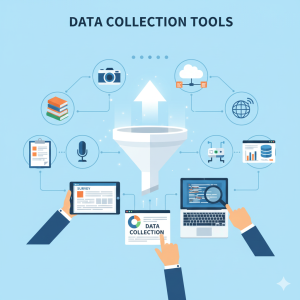
Survey platforms include SurveyMonkey, Qualtrics, Google Forms, Typeform. These streamline the creation, distribution, and basic analysis of surveys.
CRM Systems: Salesforce, HubSpot. These systems automatically accumulate huge amounts of customer information concerning their interactions, purchase history, and demographic details that are very essential during data collection and analysis related to sales and marketing.
Web Analytics Tools: Google Analytics, Adobe Analytics. These tools track website traffic, user behavior, conversions, and much more, providing invaluable insights for digital strategy.
DBMS: MySQL, PostgreSQL, MongoDB, Oracle. Highly relevant to any big dataset storage, organization, and retrieval, whether internally sourced or via external means of data collection.
Cloud Data Platforms: AWS S3, Google Cloud Storage, Azure Data Lake – These provide scalable and secure storage solutions for large datasets generated from various data ingestion tools.
ETL Tools: Talend, Informatica, Apache NiFi. Used to extract data from various sources into a consistent format and load it to a data warehouse or data lake for data collection and analysis.
Web Scraping Libraries/Frameworks: BeautifulSoup, Scrapy. Programmatic data collection tools for extracting structured data from websites in Python.
API Integrations: Many platforms, like social media and financial services, provide APIs that enable direct structured access to their data. This is a clean and efficient way of collecting data.
Sensor Data Platforms: Specialized platforms for ingesting, processing, and analyzing the data from IoT devices.
Spreadsheets: Microsoft Excel, Google Sheets. While not suitable for enormous datasets, these remain essential for smaller-scale data gathering and for preliminary organization of data.
Conclusion
Data collection is not just a matter of accumulating a heap of numbers. It is an art and science combined that brings the right information into focus, unleashing profound insights. Whether it involves tried-and-true surveys, state-of-the-art sensor streams, or web scraping, the range of methods enables data scientists to solve some of the thorniest problems and drive innovation. Understanding the importance, advantages, and range of techniques-and applying the appropriate tools effectively-means that the data science work you do will be based on sound, high-quality, relevant data. Elevating a thoughtful and strategic approach to the collection and analysis of data is, quite simply, best practice; it provides the foundation for valid, data-based decisions in the modern world.
Frequently Asked Questions
A data collection method refers to a formalized technique to collect information for research purposes from any source to address the query or test the hypothesis. These systematic methods ensure that the actual data collected later proves appropriate and correct to the goal of the data collection and analysis.
Data collection is a process of gathering and measuring information on variables of interest in a previously defined systematic way. The main types are primary data collection, which is new data gathered directly by the researcher, and secondary data collection, which involves the use of already existing data.
Typical methods of data collection are surveys QUESTIONNAIRES, interviews, observations, and the use of existing data or secondary sources. The choice of methods often goes hand in hand with the choice of data collection tool for effectiveness.


