Data Lakehouse Vs Data Fabric Vs Data Mesh: Benefits and Key Differences
In the age of big data and digital transformation, businesses usually struggle with how to architect strong, scalable, and dynamic data ecosystems. Old data warehouses and data lakes had been traditional solutions for businesses in the previous phases, but since the volume, variety, and velocity of data have grown exponentially, the shortcomings of single-purpose architecture have been revealed. Now, organizations are considering newer paradigms like the data lake house, data fabric, and data mesh to underpin analytics, governance, and agility. In order to know what's really at stake, we need to revisit the contrast between data lakes and data warehouse concepts and then contrast how newer architectures—data lakehouse, data fabric, and data mesh—respond to changing needs. This blog will explore the most important difference between data lakes and data warehouses, as well as data fabric and data mesh, real-world applications, and provide advice on how to choose the correct approach for your company.
Table Of Content
Revisiting the Difference Between Data Lakes and Data Warehouses
Understanding the Data Lakehouse
Getting Deeper into Data Fabric
Discovering Data Mesh
Data Lakehouse vs Data Fabric vs Data Mesh: Key Differences
Benefits Recap & Decision Guidance
Benefits of Data Lakehouse
Benefits of Data Fabric
Benefits of Data Mesh
Decision pointers
Conclusion
Frequently Asked Questions
Revisiting the Difference Between Data Lakes and Data Warehouses
To begin with, it is helpful to remember the difference between data lakes and data warehouse systems. A data warehouse is constructed for structured, relational data with predefined schemas, tuned for business intelligence and reporting workloads. It has schema-on-write, strong indexing, and ACID properties to guarantee uniform, performant analytics. A data lake, on the other hand, is constructed to accommodate lots of raw, semi-structured, or unstructured information, such as logs, streaming data, and multimedia. It is schema-on-read, providing flexibility but usually no strong governance, structure, and consistency.While data lakes are great at scale and data variety, they may not be as good at data quality, performance, and governance. Conventional data warehouses provide structure and reliability at the cost of flexibility and scalability when presented with large, varied, real-time data streams. These compromises led to the creation of hybrid and more flexible architectures—most significantly, the data lakehouse—which seeks to bring together the best of lakes and warehouses.
Understanding the Data Lakehouse
The data lake house (also: “lakehouse” or “data lakehouse”) represents a new data architecture that combines the openness of a data lake with the reliability and performance aspects of a data warehouse. The key concept is closing the gap between storage and analytics layers by having a single platform. A data lake house accommodates structured, semi-structured, and unstructured data and integrates storage, governance, and compute in one place.
Key characteristics of a data lake house are:
Unified storage and analytics: It supports running analytics natively on raw data without the need for additional ETL pipelines or system hops.
Low-cost scalability: Since it’s built on low-cost, scalable object storage (like data lakes are), it can grow very large without expensive infrastructure costs.
ACID transactions and schema enforcement: In contrast to normal data lakes, a data lake house introduces transactional consistency, indexing, and schema control so that updates, deletes, and concurrent reads/writes are assured.
Support for multiple data types: The architecture also supports structured tables, semi-structured logs or JSON, and even unstructured files such as images or audio.
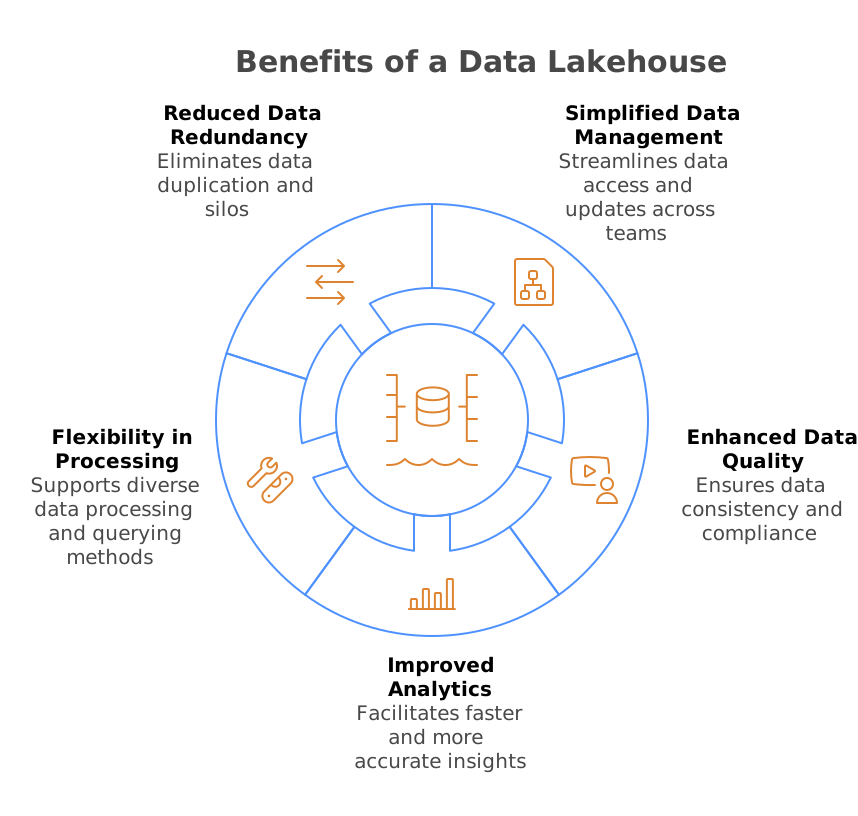
Some popular implementations include Databricks Lakehouse and Snowflake, which are both driving enterprises in this direction of a hybrid model. The benefits of embracing a data lake house are significant:
Streamlined data architecture: A single platform manages ingestion, storage, cataloging, governance, and analytics, eliminating system sprawl.
Accelerated analytics for all data types: No data movement required across multiple systems to accelerate insights.
Less movement of data: With less duplication and fewer copies, there is an improvement in latency and a decrease in operational expenditure.
A data lake house remains comparatively centralized, though, in terms of design: usually governed and governed by IT or data engineering teams. This centralization is different from more decentralized structures, such as data mesh, which disperses power and accountability across organizational boundaries.
*Kanerika
Getting Deeper into Data Fabric
A data fabric is a next-generation data architecture strategy that provides a combined, smart data integration layer over heterogeneous sources—on-premises, cloud, or hybrid. Instead of replacing storage systems, the data fabric facilitates orchestrated connectivity, metadata management, and governance across them.
The data fabric highlights:
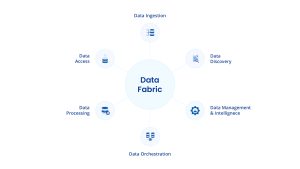
Data discovery, governance, and real-time integration: It assists businesses in finding, categorizing, safeguarding, and accessing data anywhere within their ecosystem in real time.
Automation and AI/ML for metadata management and orchestration: With smart algorithms, the data fabric can automatically label data, automate pipeline optimization, detect anomalies, and dynamically direct data flows.
Elegant data integration between platforms: Whether integrating a legacy on-prem database with a cloud-based data lake or uniting multiple SaaS sources, the data fabric serves as the glue.
Greater governance and security: Single-ended policy enforcement and visibility guarantee compliance and uniform access controls.
Real-time, self-service availability of data to business users: On-demand fulfillment of data requests without the burden of heavy engineering.
Vendors like IBM, Informatica, and Talend have come up with data fabric solutions aimed at making complex data environments easier. Data fabric does not displace data platforms; it puts a smart, governed integration and access layer on top of them.
In reality, a data fabric is best for organizations that already have a combination of data systems and need strong integration, common access, and governance. It is strong in situations where compliance, hybrid setups, and real-time access are mission-critical. Nevertheless, the data fabric remains under a model of centralized orchestration, as opposed to the domain-first approach contained within data mesh.
Discovering Data Mesh
A data mesh is a new data architecture paradigm that reinvents organizational control by thinking of data as a product and giving ownership to domain teams instead of to a central data function. Data mesh is dramatically different from the centralized architectures, like a pure data warehouse, a data lake, or even a data lake house. The defining feature of data mesh is decentralization. Its three core principles are:
Domain-specific data ownership: Business domains or units (e.g., marketing, sales, finance) own their own data pipelines and artifacts.
Data as a product: Data from each domain is owned and consumed as a product with established SLAs, quality measures, documentation, and APIs.
Self-serve data infrastructure: Domain teams can independently build data pipelines and services using shared infrastructure tools without central bottlenecks.
Federated governance: Global standards and policy are applied using lean, federated patterns instead of monolithic central control.
Advantages of data mesh are significant:
Scalability in large organizations: Since domains are independent, scaling is not reliant on one central team.
Higher agility and autonomy: Domain teams are able to iterate and react quicker to changes in the business.
Better data quality through accountability to ownership: Domains are passionate about their own data assets and therefore have higher standards.
Adopters like Netflix and Zalando have implemented data mesh concepts to drive distributed analytics and innovation. In these designs, policy guardrails are established and infrastructure provided by central teams, but domain teams build, publish, and manage their data services.
Notably, data mesh does not exclude architectures such as data lake house or data fabric; it enriches them. You may have a lakehouse as a storage and compute substrate, a fabric to offer connectivity, and a mesh that overlays domain-driven product logic. But when we contrast data lake house vs data mesh, the difference is glaring: the lakehouse is centralized, whereas mesh abdicates responsibility across domains.
Data Lakehouse vs Data Fabric vs Data Mesh: Key Differences
Feature/Aspect | Data Lakehouse | Data Fabric | Data Mesh |
Core Concept | Unified data platform combining lake and warehouse capabilities | Intelligent integration layer connecting multiple data sources | Decentralized, domain-based data management approach |
Architecture | Centralized hybrid model | Centralized orchestration layer | Decentralized and federated |
Ownership | Managed by data engineering or IT | Managed by central data teams | Owned by domain teams |
Data Governance | Centralized | Automated and policy-driven | Federated governance |
Scalability | High (through cloud and storage flexibility) | High (integration-driven) | Very high (team autonomy) |
Use Cases | Analytics, BI, ML workload | Real-time integration and governance | Large-scale organizations with distributed domains |
Examples of Technology | Databricks, Snowflake | IBM Cloud Pak for Data, Talend | Netflix, ThoughtWorks frameworks |
Contrasting the Models in Practice:
In a data lakehouse, merging storage and analytics platforms into a single architecture simplifies complexity. Enterprises experience fewer data silos, lower infrastructure costs, and easier pipelines. Because the data lakehouse supports both structure and flexibility, users gain the advantages of a warehouse’s performance alongside a lake’s scale.
The data fabric connects different systems. In environments with various data stores, like cloud, on-premises, and SaaS, the fabric allows smooth access, governance, and automation. It does not replace storage or compute layers; instead, it improves connectivity and visibility among them. It is especially effective in situations that need compliance, hybrid architecture, and real-time integration.
Data mesh represents more of a cultural and organizational shift than just a technical architecture. The main difference between data lakehouse and data mesh is who owns and operates the data. The data lakehouse centralizes control over data flows and structure, while data mesh gives authority to domain teams. By sharing responsibility, data mesh seeks to enhance agility, scalability, and domain-specific data products that better suit business needs.
In summary, each architecture tackles modern enterprise data challenges in its own way: data lakehouse focuses on unification, data fabric focuses on connectivity, and data mesh focuses on decentralization and ownership.
Benefits Recap & Decision Guidance
Benefits of Data Lakehouse
- Simplified architecture reduces maintenance work.
- Analytics can handle all data types (structured, semi-structured, unstructured).
- Less data movement and duplication occurs.
- Strong guarantees and consistency in transactions.
Benefits of Data Fabric
- Smooth integration across hybrid and multi-cloud environments.
- Automated governance, metadata management, and access control.
- Real-time, self-service data access.
- Ability to add connectivity and intelligence without replacing existing systems.
*Astera Software
Benefits of Data Mesh
- Scalability through domain-level independence.
- Greater agility and quicker results for business teams.
- Improved data quality through domain ownership and accountability.
- Flexible architecture that matches the organization’s structure.
Decision pointers
Use a data lakehouse if you want to simplify analytics and unify your data under one managed platform. It works especially well for small to medium organizations or settings with growing data complexity but not much domain fragmentation.Choose a data fabric if integration across hybrid environments, governance, and low operational friction are your priorities. It excels in situations where you already have various data systems and need a consistent access layer.
Select a data mesh if decentralization and autonomy are central to your data strategy. If your business is large, domain-driven, and mature in data ownership, the mesh model can scale without centralized bottlenecks.
In many real-world cases, hybrid or composable architectures may combine elements from two or even all three models. For instance, you might use a data lakehouse as a storage base, implement a data fabric layer for integration across systems, and follow data mesh principles for domain data ownership. The key is to align with your organizational maturity, culture, and data governance needs.
Conclusion
As enterprises grow, choosing the right modern data architecture can determine your success in using data as a strategic asset. While models like data lakehouse, data fabric, and data mesh each offer unique benefits and design ideas, the best choice depends on your organization’s size, governance needs, and culture. The data lakehouse fosters unification, the data fabric guarantees connectivity and governance, and the data mesh allows scalable independence through domain responsibility.
Ultimately, it’s not about promoting one architecture alone; it’s about using combinations, adapting practices over time, and staying flexible. In a rapidly changing digital landscape, ongoing adaptation and careful alignment with business goals will help your organization stay data-driven, resilient, and ready for the future.
Frequently Asked Questions
The difference between data lake and data warehouse is one of structure and purpose—data lakes hold raw, unprocessed data, whereas warehouses hold structured, processed data for analytics. A data warehouse medium is concerned with performance and schema consistency, while a data lake is concerned with flexibility and scalability.


