Difference Between Internal Audit and External Audit
Why do some auditors work within an organization while others assess it from the outside? For professionals navigating today’s finance, compliance, and governance landscape, understanding this distinction is essential. In a market that values transparency, accountability, and risk management, knowing the difference between internal audit and external audit can be the key to choosing the right career path.
Both internal and external auditors play vital roles in ensuring organizational integrity, one focusing on internal controls and improvement, the other providing external assurance to stakeholders. For professionals looking to upskill or transition into auditing and finance, learning what is internal audit and external audit lays the foundation for a rewarding and future-ready career.
This blog explores the difference between internal audit and external audit, highlights career opportunities in both, and explains how Jaro Education helps professionals gain the skills and credentials to succeed in this evolving domain.
Table Of Content
Understanding the Core Differences between Internal Audit and External Audit
How Does Jaro Education Help You Excel in Auditing?
Shaping Your Career Path in Auditing
Frequently Asked Questions
Understanding the Core Differences between Internal Audit and External Audit
 *bmsauditing.com
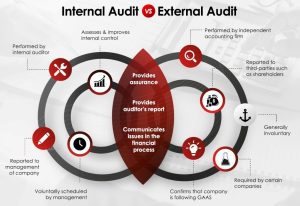
Let’s look at the difference between internal audit and external audit in a structured way through definitions, roles, focus areas, and career implications.
1. Definition and Purpose
The role of external and internal audit diverges from the outset: external auditors maintain independence to ensure credibility for external reporting, while internal auditors provide continuous insights and advisory support for internal improvement.
| Aspect | Internal Audit | External Audit |
| Definition | Conducted within the organization to assess operations, controls, and risks | Conducted by independent auditors to verify the accuracy of financial statements |
| Objective | Improve efficiency, strengthen governance, and mitigate risk | Provide assurance to shareholders and regulators that financial reports are fair and accurate |
| Reporting To | Management and Audit Committee | Shareholders or external stakeholders |
2. Scope and Focus Areas
Internal auditors often work year-round across multiple business areas, while external auditors conduct annual or quarterly statutory audits.
- Internal audit covers risk management, operational efficiency, internal controls, compliance, fraud prevention, and governance.
- External audit focuses primarily on verifying financial statements, compliance with accounting standards, and adherence to statutory requirements.
3. Independence and Objectivity
This structural distinction ensures unbiased reporting and objective recommendations in both functions.
- External auditors: are completely independent from the organization they audit and must adhere to professional and ethical standards to maintain impartiality.
- Internal auditors: operate within the organization but maintain independence by reporting directly to the audit committee or the board, not to line management.
4. Reporting and Stakeholders
Internal audit findings are action-orientated, helping management enhance performance, while external audits provide formal assurance to external stakeholders.
| Criteria | Internal Audit | External Audit |
| Main Recipients | Management, Board, Audit Committee | Shareholders, Regulators, Creditors |
| Frequency | Periodic or continuous | Typically annual |
| Report Type | Internal advisory reports with improvement suggestions | Formal audit opinion attached to financial statements |
5. Frequency and Timing
Internal audits may occur monthly, quarterly, or on a rolling basis. They can be triggered by specific events, risks, or process changes.
External audits are typically annual and coincide with financial reporting cycles.
The difference between internal audit and external audit here lies in timing flexibility; internal audits are proactive and continuous, while external audits are periodic and retrospective.
6. Skills, Expertise, and Career Pathways
*testgorilla.com
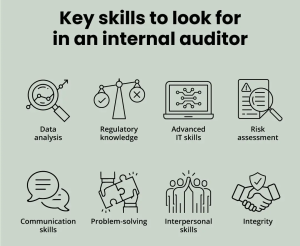
Common Core Skills
- Analytical and critical thinking
- Accounting and auditing knowledge
- Risk management and compliance awareness
- Strong communication and data interpretation
Specialized Skills
The role of external and internal audit requires continuous learning, strong ethics, and adaptability as technology transforms auditing practices.
| Internal Audit | External Audit |
| Business operations knowledge | Deep understanding of financial reporting standards |
| Process improvement and risk analysis | Compliance and statutory expertise |
| Use of data analytics for continuous auditing | Application of audit frameworks (e.g., ISA, GAAP) |
| Cross-functional collaboration | Client relationship management |
Career Growth Pathways
- Internal Audit Careers: Start as an Internal Auditor → Senior/Internal Audit Manager → Head of Audit/Risk → Governance/Compliance Director.
- External Audit Careers: Start as Audit Associate → Audit Manager → Partner or Director at audit firms → CFO/Controller in corporates.
7. Pros, Cons, and Market Demand
Before choosing a specialization, it’s important to evaluate the real-world advantages, limitations, and market relevance of each audit role. Understanding these aspects will help professionals make informed career decisions and align their learning goals with industry demand.
| Category | Internal Audit | External Audit |
| Pros | Closer to operations, offers business insight, regular work schedule | Independent, exposure to multiple industries, high professional recognition |
| Cons | Limited external visibility, potential internal bias | Intense deadlines, extensive travel, high seasonal workload |
Market Outlook and Compensation
- Average Auditor Salary in India: ₹6.8 lakh per year (combined average).
- Internal Audit: Mid-level professionals earn ₹7–12 LPA; senior professionals can earn ₹12–18+ LPA.
- External Audit: Depending on firm and experience, salaries can range from ₹8 LPA for associates to ₹40+ LPA for partners or specialized consultants.
Rising corporate governance regulations and increased reliance on risk assurance functions are fueling steady demand for skilled internal and external auditors across finance, IT, and manufacturing sectors.
How Does Jaro Education Help You Excel in Auditing?
Professionals aspiring to master the nuances of internal and external audits can rely on Jaro Education for comprehensive, industry-relevant learning pathways.
Trusted Collaborations and Expert Faculty
Jaro Education partners with leading universities and institutions, offering degree and certification programs in finance, audit, and risk management. These programs are curated with academic and industry experts to ensure alignment with evolving market needs.
Learning Experience and Flexibility
- Format: 100% online or blended learning with live sessions and recorded modules.
- Faculty: Domain experts and industry practitioners offering real-world insights.
- Learning Support: Personalized mentoring, interactive sessions, and career counseling.
Course Highlight
Online MBA – Manipal University, Jaipur
Feature | Details |
Ideal For | Finance professionals, auditors, compliance officers, career switchers |
Skills Covered | Risk management, internal controls, external audit standards, and regulatory compliance |
Value Additions | Jaro Connect (networking platform), alumni access, and expert guidance |
Note: For degree programs, Jaro facilitates the learning experience and provides career counselling, but is not the degree-granting authority.
Shaping Your Career Path in Auditing
Choosing between internal and external auditing is not merely about job titles—it’s about aligning your strengths with your professional aspirations. The difference between internal audit and external audit lies in purpose, scope, and impact. Internal auditors strengthen an organization from within; external auditors safeguard stakeholder confidence from outside. Both contribute to business integrity and trust.
For professionals seeking to future-proof their careers, a combination of strong foundational knowledge, advanced training, and ongoing skill enhancement is key. With Jaro Education’s industry-aligned programs and expert mentoring, you can take confident steps toward mastering the audit landscape and unlocking new professional possibilities.
Frequently Asked Questions
Jaro offers personalized counseling, academic guidance, and access to Jaro Connect, which provides career services, alumni networking, and industry insights.
Unlike generic online courses, Jaro’s programs are exclusive collaborations with IITs, IIMs, and leading universities. Learners benefit from a structured curriculum, expert faculty, and industry-oriented insights.


