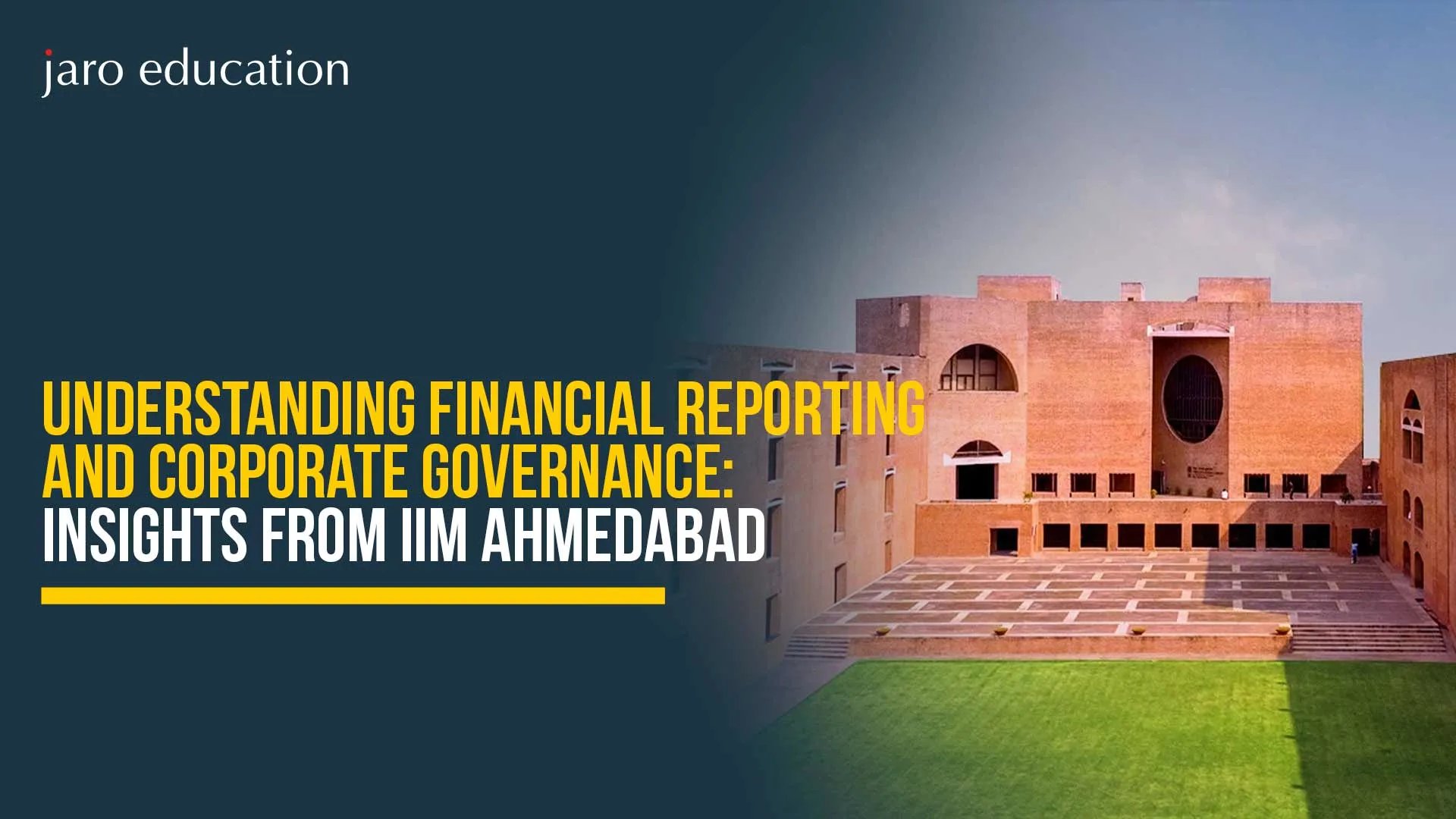
Understanding Financial Reporting and Corporate Governance: Insights from IIM Ahmedabad
In today’s highly competitive and transparent business environment, understanding the language of finance is no longer optional—it’s essential. Whether you’re a corporate executive, entrepreneur, financial analyst, or manager, a robust understanding of financial reporting and governance empowers you to make better strategic decisions, detect early warning signs, and ensure accountability within your organisation.
As global financial markets become more integrated and regulation becomes stricter, the role of corporate financial reporting and governance has taken centre stage. Companies are now expected not only to maintain accurate records but also to communicate their financial health in a manner that is honest, consistent, and transparent. This evolving responsibility calls for more than just traditional number-crunching; it demands insight, interpretation, and integrity.
In this article, we will explore the importance of financial reporting, break down its core objectives, analyse its key users, and examine the critical relationship it shares with corporate governance. We will also provide insights into how professionals can sharpen their skills and understanding through advanced academic programs like the Financial Reporting and Corporate Governance – IIM Ahmedabad.
Table Of Content
What is Financial Reporting?
Objectives of Financial Reporting
Who Are the Users of Financial Reporting?
Role of Financial Reporting and Analysis in Business Strategy
Corporate Financial Reporting: More Than Numbers
Link Between Financial Reporting and Corporate Governance
Bridging Theory and Practice: Learning from IIM Ahmedabad
Challenges in Financial Reporting: Fraud, Earnings Manipulation & Governance Risks
Best Practices in Financial Reporting and Transparency
Role of Technology in Corporate Financial Reporting
Creating a Financial Performance Analysis Project Report: Step-by-Step
Final Thoughts
Frequently Asked Questions
What is Financial Reporting?
At its core, financial reporting is the process of disclosing financial data and information about a company’s performance, financial position, and cash flows over a specific period. It involves the preparation and presentation of standardised financial statements such as the balance sheet, income statement, cash flow statement, and accompanying notes.
Unlike internal accounting records used for day-to-day management, financial reporting focuses on presenting a fair and true picture of the company’s overall health to a wide array of external stakeholders. It forms the basis of trust between a business and its investors, regulators, suppliers, creditors, and the public.

Objectives of Financial Reporting
Understanding the objectives of financial reporting is the foundation of appreciating its value in corporate strategy and governance. These objectives are not just technical—they are tied to the very credibility and sustainability of a business. The major objectives of financial reporting include:
- Transparency: Presenting accurate and timely data helps establish trust with stakeholders.
- Comparability: Standardised formats allow financials to be compared across time periods and between companies.
- Decision-making: Investors and managers use financial reporting and analysis to guide strategic choices.
- Accountability: Financial reports ensure that businesses are held responsible for how they manage resources.
- Compliance: Meeting legal and regulatory requirements through comprehensive and honest disclosures.
In essence, the objectives of financial reporting go beyond accounting—they represent the ethical compass of a business.
Who Are the Users of Financial Reporting?
Senior executives rely on both internal and corporate financial reporting to make data-driven strategic decisions.
Knowing the users of financial reporting reinforces the importance of clear, accurate, and tailored financial communication.

Role of Financial Reporting and Analysis in Business Strategy
Beyond compliance, financial reporting and analysis provide a lens through which the health and trajectory of a company can be examined. Effective financial reporting and analysis supports:
- Budget planning and forecasting
- Performance benchmarking
- Cost control and efficiency improvements
- Valuation and merger readiness
- Investment and capital allocation decisions
Professionals engaged in financial performance analysis project report creation understand the deep strategic value such analysis holds. These reports don’t just capture what happened; they help predict what might happen and guide what should be done next.
Corporate Financial Reporting: More Than Numbers
While corporate financial reporting might seem like a numbers game, it’s much more than that. It embodies the ethical and governance framework of an organisation. Corporate leaders must ensure that their financial disclosures reflect both accuracy and integrity.
Key characteristics of high-quality corporate financial reporting include:
- Reliability: The data must reflect the real-world position of the company.
- Relevance: Only material information that can influence decisions should be included.
- Consistency: Reports should follow a consistent methodology over time.
- Understandability: The presentation should be accessible, even to non-specialists.
High-stakes decisions—including capital raising, restructuring, or partnerships—depend heavily on the strength of corporate financial reporting.
Link Between Financial Reporting and Corporate Governance
Financial reporting and corporate governance are two sides of the same coin. While one deals with communicating business performance, the other ensures that such communication is done responsibly, ethically, and under proper oversight.
Corporate governance provides the framework through which company objectives are set and performance is monitored. It includes:
- Board structure and independence
- Internal audit systems
- Ethics and compliance protocols
- Transparency in disclosures
- Shareholder rights
Poor governance often leads to manipulated or misleading financial reporting, which can result in fraud, loss of investor confidence, or legal consequences. This is where the knowledge of financial performance analysis, project report methodologies, and forensic tools becomes essential.
Professionals who understand both disciplines can act as guardians of financial integrity, bridging the gap between operations, compliance, and public accountability.
Bridging Theory and Practice: Learning from IIM Ahmedabad
To navigate today’s complex financial landscape, professionals must master not only the technical aspects of financial reporting but also the interpretive and ethical frameworks behind them. This is precisely the approach adopted by the Financial Reporting and Corporate Governance – IIM Ahmedabad program.
Designed for executives, entrepreneurs, and finance professionals, this four-month blended program offers a rigorous foundation in financial accounting, fraud detection, earnings manipulation, and governance principles. Participants explore the entire financial reporting lifecycle—from understanding frameworks to interpreting key documents such as balance sheets, income statements, and cash flow statements.
With live online sessions, immersive campus modules, and real-world case studies, the program emphasises both theoretical learning and hands-on application. Participants leave equipped not just with knowledge but with skills to make high-stakes financial decisions with clarity and confidence.
Challenges in Financial Reporting: Fraud, Earnings Manipulation & Governance Risks
Best Practices in Financial Reporting and Transparency
Role of Technology in Corporate Financial Reporting
Creating a Financial Performance Analysis Project Report: Step-by-Step
Final Thoughts
In a world shaped by rapid change, globalisation, and digital acceleration, financial reporting is no longer confined to accountants and auditors. It is a critical leadership skill. Similarly, governance is no longer a compliance checkbox—it is a measure of a company’s integrity and sustainability.
Together, they form the foundation of ethical leadership, sound decision-making, and long-term stakeholder value. Leaders who understand corporate financial reporting, who recognise the importance of clarity in communication and governance, will always be ahead of the curve.
If you’re looking to sharpen your understanding of both domains and apply it confidently in the real world, the Financial Reporting and Corporate Governance – IIM Ahmedabad program is a smart investment in your future.
Jaro Education invites professionals and decision-makers to enrol in the Financial Reporting and Corporate Governance – IIM Ahmedabad program. With expert faculty, real-world cases, and a blended learning experience, the course prepares you to lead with insight, integrity, and confidence in today’s financial landscape.
Frequently Asked Questions
Accurate and transparent financial reporting builds trust with investors by showcasing a company’s performance and future potential. It reduces perceived risk and increases the likelihood of investment and long-term shareholder retention.
Internal financial reporting is used by company management for strategic decision-making and may include customised dashboards or projections. External reporting follows standardised formats for users of financial reporting, like investors, regulators, and creditors.
Yes, weak governance often results in misleading corporate financial reporting, a lack of accountability, and ultimately, financial mismanagement or fraud, undermining a company’s credibility and performance.
No, while public companies must disclose their financials publicly, private companies also rely on structured financial reporting and analysis to secure funding, evaluate performance, and meet legal or internal compliance standards.
Professionals must master financial statement interpretation, ratio analysis, forecasting, industry benchmarking, and report writing to prepare and evaluate a comprehensive financial performance analysis project report.


