
JEE Advanced: India’s Toughest Engineering Exam
Every year, thousands of aspirational students dream of gaining admission to the renowned Indian Institutes of Technology, commonly referred to as the IITs. But there is nothing but an obvious obstacle between these dreamers and their wishes–the JEE Advanced exam. JEE Advanced is considered by many to be the toughest engineering entrance exam in India, challenging not only the student’s ability to be competent but also their determination, resilience, and smart and efficient preparation methods.
So, if you’re one of those students who is preparing for this example and needs clarity about it, this blog is definitely for you. Here, we will discuss what JEE Main and Advanced are, the number of attempts for JEE Advanced, the eligibility criteria, exam pattern, and a few preparation tips. This blog is going to be very useful, so let’s dive in.
Table Of Content
What is JEE Main and JEE Advanced?
Eligibility Criteria for JEE Advanced
How many attempts for JEE Advanced?
JEE Advanced Exam Pattern and Syllabus
Preparation Strategies For JEE Advanced
Prepare with Courses on Jaro Education
Conclusion
Frequently Asked Questions
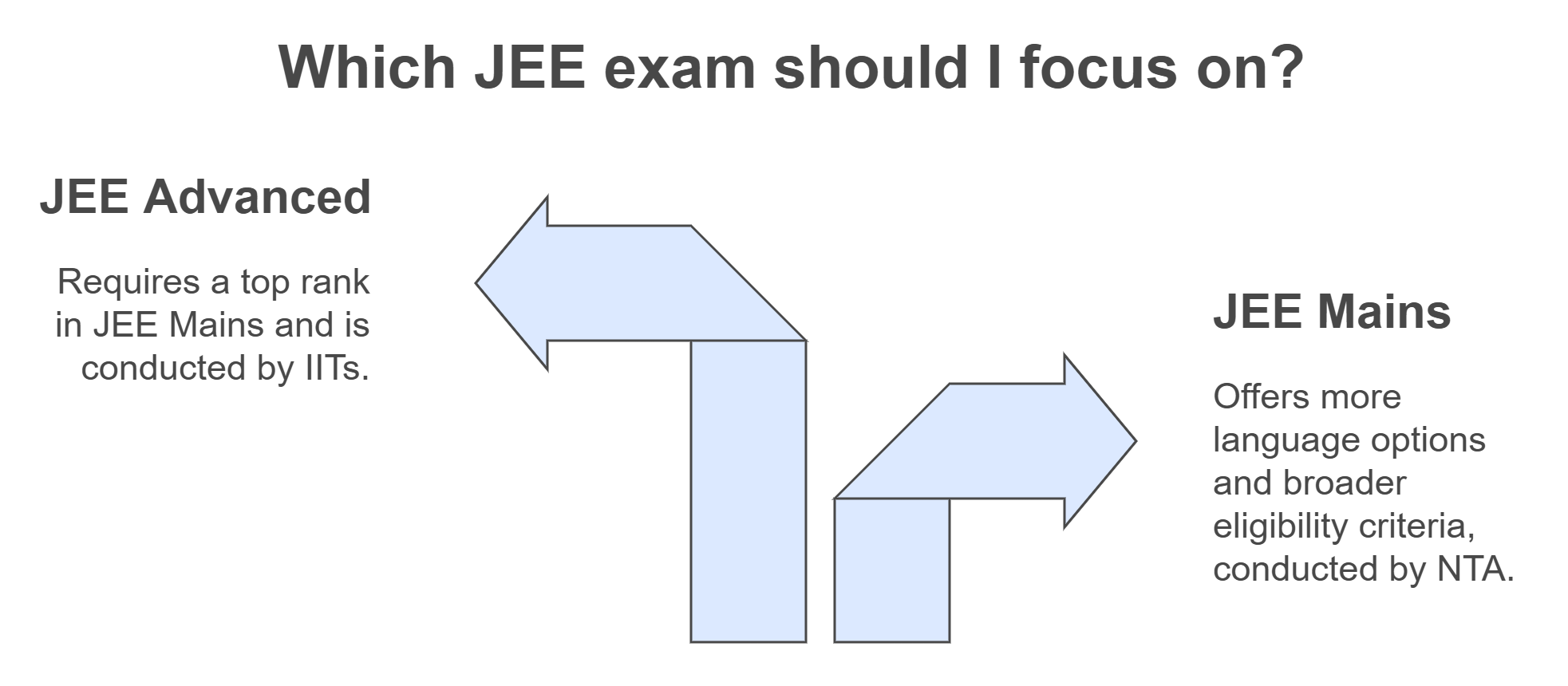
What is JEE Main and JEE Advanced?
- Held once in a year.
- It is only for admission into IITs.
- JEE Advanced is known for its unpredictable exam patterns, and it is relatively difficult compared to the JEE Main exam.
- This tests not only a students’ conceptual understanding but also their analytical skills, logical reasoning, and time management.
Eligibility Criteria for JEE Advanced
Even after clearing JEE Advanced, admission to IITs is not a simple process. Candidates must also meet the given below eligibility criteria:
- General Category: Minimum 75% aggregate marks in Class 12 with Physics, Chemistry, and Mathematics as core subjects.
- SC/ST/PwD Candidates: Minimum 65% aggregate marks.
- Alternative Eligibility: Candidates must be within the top 20 percentile of their board results.
- JEE Main Result: Only the top 2,50,000 candidates who appeared in JEE Main are eligible for JEE Advanced.
- Age Limit: Candidates must be born on or after 1st October 2000 (with a 5 year relaxation for SC/ST/PwD candidates).
The marks of five subjects are considered:
- Physics
- Chemistry
- Mathematics
- One language (highest score considered if more than one)
- One other subject (highest score considered)
How many attempts for JEE Advanced?
- Your first attempt can be in the same year you take your Class 12 board exams (assuming you clear JEE Main and qualify for JEE Advanced).
- Your second attempt, or only, in the same year is the following year. So over the next year, after it has been an attempt after Class 12, you will no longer be able to sit for JEE Advanced again.
JEE Advanced Exam Pattern and Syllabus
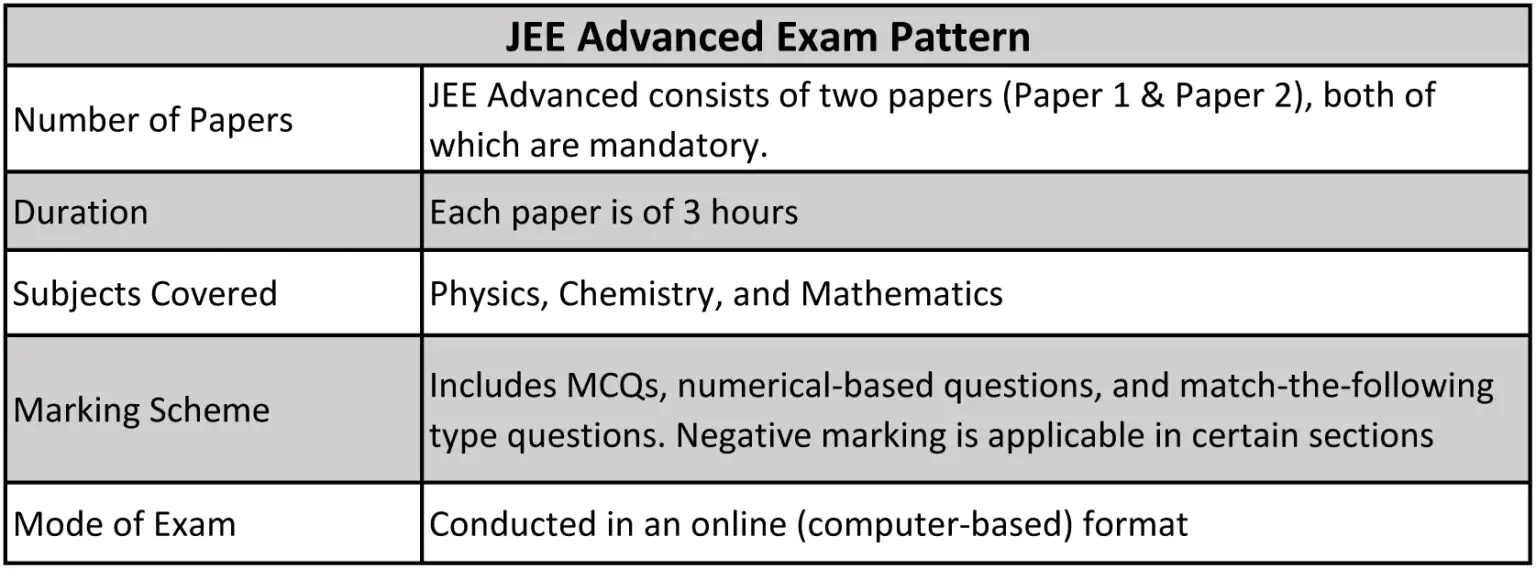
The JEE Advanced syllabus consists of Physics, Chemistry, and Maths from classes 11 and 12. The most difficult thing about JEE Advanced is its dynamic exam pattern. Unlike other entrance exams, where candidates are notified about the details and scheme related to the exam beforehand, JEE Advanced keeps this a secret until the exam day. Candidates only get the aspects given below of the exam pattern:
- Two Papers (Compulsory): Paper 1 and Paper 2, each of 3 hours.
- Subjects: Physics, Chemistry, and Mathematics in both papers.
- Mode: Computer-based test in English and Hindi.
- Dynamic Marking: Full, partial, and negative marking depending on question type.
- The syllabus covers Class 11 and 12 topics but the depth of questions is significantly higher.
Preparation Strategies For JEE Advanced
Since only two attempts are allowed for JEE Advanced, it is important that you prepare wisely. Here’s how you can maximize your chances:
- Understand the Complete Syllabus – Start preparing with NCERTs to understand every concept clearly, before moving on to advanced reference books.
- Practice Previous Years’ Papers – Pay attention to the level of difficulty of papers, and the pattern of questions, and notice the trends in JEE Advanced.
- Practice Your Time Management Skills – While preparing, complete every question within time limits to improve your speed and accuracy.
- Take Mock Tests Regularly – Try to mimic the real exam experiences, in order to give yourself a boost in your confidence and to give you an idea of where your weaknesses are.
- Balance Your Study Plan – Keep an equal focus on Physics, Chemistry and Mathematics so that there are no gaps in your preparations.
- Revise Regularly – Always revise your formulas, concepts and strategies for solving problems regularly.
Prepare with Courses on Jaro Education
Many courses on Jaro Education can help you prepare for the knowledge required for the JEE Advanced. While you should always check the syllabus and take practice exams to ensure you are on the right track, consider getting started by taking maths and science courses to build your foundation and prepare for more advanced coursework.
Conclusion
Undoubtedly, IITs are considered to be the pinnacle of engineering education, not only in India but globally. Being one of the toughest engineering entrance exams in India, candidates feel tremendous pressure to do well and fear of not clearing it. But fret not, with the right guidance and preparations, cracking such exams become easier.
To support your journey and success ki Tiaiyari, Jaro Education is here to offer personalised guidance and career counseling to ensure you are on the right track of achieving your dream. We also bring several online certification programmes and online degree courses that align with your career goal. Visit our website to explore our courses and how we support you through your academic journey.
Frequently Asked Questions
No. Candidates can attempt JEE advanced maximum two times in two consecutive years.
The JEE Advanced 2026 exam will be held in May 2026. The most probable dates for the JEE Advanced 2026 exam are May 17 or May 24.
The age limit for JEE advance is 19 years.


