
Leveraged Buyout Guide: Meaning, Model & Famous Examples
Consider purchasing a company worth billions without paying the full cash price upfront. Sounds impossible, right? That’s the power of a leveraged buyout (LBO). But what is a leveraged buyout? Basically, a leveraged buyout is when investors utilize a combination of their equity and a large amount of debt – often with loans secured against the company’s assets – to acquire a company.
At the core of the leveraged buyout is a high-risk, high-return model, evidenced by the most famous deal involving RJR Nabisco in 1988. Whether you’re looking for the full meaning of LBO, wondering about the leveraged buyout model, or searching for a leveraged buyout example, this article will give you a guide to understanding leveraged buyouts for beginners.
Table Of Content
Definition of Leveraged Buyout: Understanding the Basics
LBO Full Form and the Concept Behind a Leveraged Buyout
What is LBO Valuation
How Does a Leveraged Buyout Work? Step-by-Step Explanation
Leveraged Buyout Model: Key Components and Structure
Leveraged Buyout Example: Real-World Case Studies
Advantages and Risks of a Leveraged Buyout
Leveraged Buyout vs Other Acquisition Strategies
Conclusion
Frequently Asked Questions
Definition of Leveraged Buyout: Understanding the Basics
LBO Full Form and the Concept Behind a Leveraged Buyout
Think of it like purchasing a business using a loan, and the company you purchase aids in paying it off. This is to say that the buyer provides a small amount of his/her own funds and borrows the rest. The advantage of LBO is the ability to invest through the acquisition of a big enterprise without the cumbersome cash availability. It is an aggressive financial planning-potent when successful, but dangerous in the event of the firm not being able to generate sufficient returns.
What is LBO Valuation
How Does a Leveraged Buyout Work? Step-by-Step Explanation
Think of the car you have always wanted to purchase, but it is not affordable. You put a little down payment, borrow the difference, then use it to make money (e.g, as a rental car). The loan is paid over time through the rental income, and after the period, the car is yours. This is basically how a leveraged buyout (LBO) works – only on a much larger scale with companies versus cars.
The step-by-step process of a leveraged buyout is as follows:
1. Identify a Target Company
The analysis will start with the identification of a company with good cash flows, a stable business, and potential business growth. Interesting titbit: LBO targets tend to be in mature industries such as manufacturing, healthcare, or retail, and the percentage of LBO target companies in this category of industries is around 70%.
2. Secure Financing
Buyers borrow to purchase a down payment, similar to the way people borrow a mortgage to buy a house. Indeed, it has been demonstrated that on average, between 60 and 80 percent of the LBO funding is borrowed capital.
3. Acquire the Company
The investors become the owners of the company by paying debt with an addition of a small amount of equity (normally 20-40 per cent).
4. Improve Performance
Now the game really starts. Investors reorganize, reduce expenses, or capitalize operations to enable the company to be more profitable. A PwC report noted that more than 65 percent of the LBO-backed firms enhance EBITDA within 3 years.
5. Eliminate Debt and Quit
When the company begins to generate cash, the investors pay off the loan and, at a later stage, sell the enterprise, usually at a higher valuation. On average, the LBO’s returns targeted by the private equity firms amount to 20 30% a year.
Basically, a leveraged buyout is a risky yet profitable method of using leveraged debt money to generate hefty returns as long as the investment is successful.
Leveraged Buyout Model: Key Components and Structure
1. Role of Debt and Equity in a Leveraged Buyout Model
Selecting a model of a leveraged buyout (LBO) involves some balancing between debt and equity. The purpose of the model is to present a range of possibilities. The model also performs the task of illustrating the concept of a leveraged buyout. Models are established to prove a point or demonstrate a concept. Models can be applied in many ways with various considerations. Leveraged buyout models have stressors or considerations against them.
In the majority of LBOs, the cash outlay is made up of debt (60-80 percent) and equity (20-40 percent). Such a balance is so important because:
Debt (The Lever):
The debt financing is the pillar of an LBO. By borrowing money, the investors minimise the amount of cash required to invest. As an example, the average debt leverage employed by the private equity firms in the U.S. in buyout transactions in 2024 was 68 percent.
Equity (The Cushion):
Equity is provided by the investors(private equity firms or sponsors). Although it constitutes a smaller share, it also serves as a safety net and makes sure that the deal has skin in the game.
Together, debt enhances possible return and equity absorbs risk – making the structure also aggressive and strategic.
2. Financial Strategies Used in a Leveraged Buyout
A high-quality LBO goes beyond, in itself, raising funds; the key to a successful LBO is unlocking value through financial engineering. Cost reduction, improvements in quality, and new products are just some of the common strategies.
Cost Optimization:
Elimination of operational inefficiencies to unleash profitability. It has been found that 75 percent of the LBO-supported businesses are involved in cost reformulation in the initial 2 years.
Revenue growth:
penetrating new markets, introducing new products, or acquiring smaller firms.
Asset Sales:
Simply put, selling off non-core divisions or underperforming assets so that debt can be reduced within a short time.
Dividend Recapitalization:
In other instances, firms acquire additional debt in order to provide dividends back to investors, as an assurance of early returns.
Debt Paydown:
repayment of debt during the improving cash flows will raise equity value over time.
Bain & Company Global Private Equity Report 2024 stated that 70 percent of LBO gains do not emanate due to market timing only, but also the improvement of operations and reduction of debt.
Leveraged Buyout Example: Real-World Case Studies
| Case Study | Year | Buyer | Deal Value | Debt Financing | Strategy/Impact | Outcome |
| RJR Nabisco | 1989 | KKR (Kohlberg Kravis Roberts) | $31.1 billion | ~90% debt | Highly leveraged acquisition, but it led to financial struggles | Put KKR on the global map; inspired “Barbarians at the Gate” |
| Hilton Hotels | 2007 | Blackstone Group | $26 billion | Significant debt, restructured later | Debt restructuring + global expansion | Went public in 2013 at $32 billion; one of the most successful LBO exits |
| Dell Computers | 2013 | Michael Dell & Silver Lake | $24.9 billion | Large debt component | Restructure away from Wall Street pressure; focus on cloud & enterprise | Returned public in 2018 at $70+ billion valuation |
Advantages and Risks of a Leveraged Buyout
1. The benefits of Leveraged Buyout
Big Returns to Investors
Given that the strategy pays off, the gains can be massive when compared with money invested.
Increased Operational Efficiency
Private equity firms usually undertake restructuring of companies, cost reduction efforts, and rationalization of operations, which makes the business leaner and more competitive.
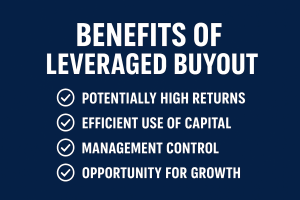
Tax Savings
Interest on debt is tax-deductible, and LBOs may save you all kinds of taxes.
Incentivized Management
The management teams normally have some equity participation, which highly motivates them to help build the company and increase value.
2. Risks of a Leveraged Buyout
High Mortgage
Barring excessive borrowing, a high mortgage can break an enterprise when cash flows become reduced, and bankruptcy could be a reality.
Lay-offs and Cultural Change
Due to the need to budget, some lay-offs are bound to be experienced, as well as internal cultural changes.
Economic Downturn Risk
LBOs are placed in stable markets. An unexpected downturn in the economy or market may hobble the plans to repay.
Internal Reputation Damage
Keep in mind that drastic restructuring could be bad for the long-term reputation of a company.
Put shortly, a leveraged buyout is comparable to a game of high-stakes poker: there can be a fortune made, but the game can be a disaster.
Leveraged Buyout vs Other Acquisition Strategies
Leveraged Buyout (LBO)
A deal is funded mostly through borrowed funds.
The goal of the investors is to maximize the return on their investment through the company’s own assets (or cash flow) to pay off the debt.
High risk, high reward.
Traditional Acquisition
Company uses either cash or stock to buy another company.
Lower risk as debt is manageable.
Focus is on synergy and growth rather than saturation and aggressive portfolio reengineering.
Management Buyout (MBO)
The company’s management buys out the ownership, with financing typically provided by an external party.
This adds continuity of management.
Similar to the traditional acquisition process but less disruptive than an LBO.
Asset Purchase
It is a transaction where a buyer is NOT acquiring the company as a whole, but rather buying specific assets, such as specific technology, patents, divisions, or cost liabilities.
Limits liabilities and risk.
Typically, when a company is in distress clear-out or some level of restructuring is required.
The Key Distinction?
Most acquisition-type strategies will emphasize growth and stability as building blocks for being successful, while a leveraged buyout focuses on debt-based transformation, which is a bigger bet – more aggressive.
Conclusion
An LBO can seem complicated; however, it is nothing more than a corporate buying process where companies are purchased with both leverage and equity. The leverage buyout definition is designed to generate high returns, but the enterprise is associated with a great risk. Examining the leveraged buyout model and looking at some of the most well-known examples of leveraged buyouts, novices can observe just how potent this instrument is in the field of corporate finance. The next time someone asks you, What is a leveraged buyout? Refer back to the LBO full form- Leveraged Buyout, which is not just a piece of jargon but also a financial shot in the arm.
Frequently Asked Questions
A leveraged buyout (LBO) is when a company is acquired using a large portion of borrowed money, with the target company’s assets or future cash flows often used as collateral.
By definition, leveraged buyouts provide the highest returns to private equity firms and sometimes management. The leveraged buyout model and LBO valuation help ensure the deal benefits investors while managing risk.


