What Is Data Mining? A Beginner’s Guide
In today's digital-first world, organizations generate massive volumes of data every second. But data alone has no value unless analyzed, interpreted, and converted into meaningful insights. This is where data mining emerges as one of the most powerful technologies. Understanding what data mining is helps an individual or business make informed decisions using hidden patterns and trends.
Enterprises have adopted the technique of data mining over time to extract business intelligence from customer journeys, financial data, transaction logs, and operational systems. Increased dependency on insights-driven strategies hastens the need towards understanding the process of data mining, especially for beginners.
Data mining is considered the heart of analytics, where raw data becomes actionable intelligence. As organizations expand their digital footprint, learning what data mining is becomes essential for professionals across marketing, finance, IT, e-commerce, and more.
Table Of Content
What is Data Mining?
Why is Data Mining Important?
How Data Mining Works
Benefits of Data Mining
Data Mining Process: Step-by-Step Explanation
Key Data Mining Techniques
Data Mining Use Cases
Future of Data Mining
Conclusion
Frequently Asked Questions
What is Data Mining?
The basis of data mining is uncovering hidden knowledge and insights that may elude traditional methods of analyses. Data mining techniques are utilized extensively in organizations to extract customer behavioral patterns, fraud detection, sales prediction, supply chain optimization, and personalization of user experience.
Understanding the data mining process is important because it forms the backbone of how insights are extracted and used for business transformation.
Why is Data Mining Important?
Companies all over the world are using data mining techniques to identify operational inefficiencies, enhance customer targeting, and improve product strategies. With the continuous evolution of AI and machine learning, the data mining process now allows organizations to automate tasks that once required extensive manual analysis.
From improving customer segmentation to detecting anomalies in transactions, data mining empowers industries in innovation and scalability. This makes learning what data mining is extremely valuable for any entrant into the digital economy.
How Data Mining Works
Advanced data mining techniques are then used to clean, transform, and model this information. The cleaned and prepared data is then run through a wide range of statistical models, machine learning algorithms, and pattern recognition methods to come up with hidden insights.
Data mining tools can analyze millions of data points in mere seconds, therefore helping businesses uncover correlations and trends they never knew existed. To anyone learning what is data mining, this workflow provides a foundation for further exploration.
Benefits of Data Mining
Below are key benefits:
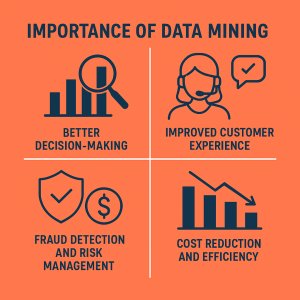
1. Better Decision-Making
Companies utilize powerful data mining methods to transform raw information into strategic decisions. In fact, the ability to understand consumer preferences and market trends through the process of data mining results in better forecasting and planning.
2. Better Customer Experience
When organizations understand what data mining is, it becomes easier for them to analyze customer behavior patterns and provide personalized services. This leads to personalized recommendations, targeted campaigns, and optimized communication.
3. Fraud Detection and Risk Management
Financial institutions practice advanced data mining in order to identify suspicious transactions to reduce risks. Learning data mining processes helps a beginner to show how predictive models identify anomalies in real time.
4. Cost Reduction and Efficiency
They learn how automation and insight-driven processes reduce operational costs by understanding what data mining is for an organization. Data insights assist in eliminating guesswork and increasing efficiency across all departments.
5. Improved Product Development
Using data mining techniques, companies assess market demand, competitor strategy, and customer reviews. The data mining process ensures that product teams build solutions the customers truly need.
Data Mining Process: Step-by-Step Explanation
The detailed process is as follows:
1. Business Understanding
The business defines the problem and the expected outcome before any data mining techniques are applied. This is necessary to guarantee that strategic goals are met during the data mining process.
2. Data Collection
In the initial phase of learning ‘what is data mining’, one has to understand that high-quality data is crucial. Data comes from numerous sources such as CRM systems, sensors, web logs, and external datasets.
3. Data Cleaning and Preparation
Raw data typically has errors. To cleanse this dataset and bring some structure into it, organizations apply data mining techniques. This stage forms 60–70% of the data mining process.
4. Modeling
In data mining, machine learning algorithms are applied for the identification of patterns, namely, clustering, classification, regression, and association models.
5. Evaluation
Insights are tested for accuracy. Results from data mining are measured against business expectations during the mining process.
6. Deployment
Finally, the insights are integrated into dashboards, reports, AI models, and business decisions. This is the end of the cycle for understanding what is data mining.
Key Data Mining Techniques
1. Classification
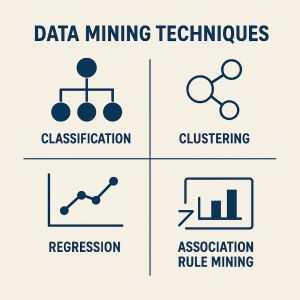
Classification summarizes data into pre-defined categories. Analysts who learn what is data mining use algorithms like decision trees, Naive Bayes, and Support Vector Machines to classify datasets.
2. Clustering
Clustering groups similar data points without predefined labels. This is one of the most widely used data mining techniques in marketing. Clustering supports segmentation, an important part of the data mining process.
3. Regression
Regression helps in the determination of the relationship between variables. Any person studying what is data mining will find regression models being used for sales forecasting and financial predictions.
4. Association Rule Mining
This technique identifies the relationship between variables, such as retail buying patterns. Many data mining techniques rely on association rules to optimize inventory and marketing. It plays a major role in the data mining process.
5. Outlier Detection
By detecting unusual data, it aids organizations in fraud prevention. In turn, identifying what constitutes data mining gives prominence to anomaly detection in cybersecurity, finance, and IT systems.
6. Neural Networks
Deep learning models are powered by neural networks. These advanced techniques of data mining work like the human brain, therefore enhancing predictions and automations in the data mining process.
Data Mining Use Cases
1. Retail & E-Commerce
The data mining process is used by retailers to analyze consumer purchasing behavior. Professionals interested in what is data mining will find this area applied in personalized product recommendations, dynamic pricing, and inventory planning.
2. Banking & Finance
The data mining techniques are applied for fraud detection and the evaluation of loan risks in financial institutions. Anyone learning what is data mining will understand how credit scoring models rely heavily on analytical algorithms.
3. Healthcare
records. Predictive diagnosis and patient risk assessments help healthcare professionals understand what is data mining from a real-world perspective.
4. Marketing & Advertising
Marketers target campaigns using data mining techniques. Understanding what is data mining helps advertisers predict customer preferences and increase ROI.
5. Manufacturing
The data mining process is used by manufacturers to detect equipment failures before they actually happen. Predictive maintenance reveals the power of what is data mining in operational efficiency.
6. Telecom & IT
The telecom companies predict churn and optimize their networks using data mining techniques. At the same time, beginners will learn how the improvement in customer retention is influenced by what is data mining.
7. Education & EdTech
Data analytics help educators identify student learning patterns. This is one more sector in which data mining provides academic insights that are incredibly useful.
Future of Data Mining
Knowing what is data mining also entails understanding its potential in the future. Due to the advent of artificial intelligence, automation, and big data, the concepts of data mining are getting modernized very quickly.
Generative AI, natural language processing, and deep learning are some of the important technologies that further advance the power of data mining techniques. Today, real-time analytics embedded in the data mining process can facilitate instant decision-making.
With the expansion of intelligent systems, learning what is data mining becomes important for any career interacting with data.
Conclusion
Data mining has become an indispensable skill these days in industries like finance, healthcare, and retail. This data mining guide explains everything about what is data mining, its definition, advantages, working process, techniques, and real-world applications.
Various data mining techniques can be explored to understand how organizations gain insights and develop strategies. Understanding the data mining process helps the beginner take the first step toward a data-driven professional.
Frequently Asked Questions
Organizations use data mining for wiser decision-making by uncovering hidden trends, which explains what data mining really is in real-world use. Advanced data mining techniques and an effective data mining process boost business predictions, efficiency, and customer strategies.
The three major types are: descriptive, predictive, and prescriptive analysis; each helps in defining what is data mining in various contexts. These rely on a number of data mining techniques and guide the overall data mining process to obtain accurate insights.


