What is Financial Risk Management? Key Insights Explained
In today's fast-paced and uncertain financial world, the need to protect assets, investments, and business operations is very important. It is for this reason that financial risk management acts as a strategic shield. Most businesses, investors, and even individuals depend on structured processes that identify, evaluate, and minimize financial threats. Understanding what is financial risk management allows you to make smarter decisions, build resilience, and ensure stability even during economic fluctuations.
Before we get into the deeper layers of the concept, it is first important to understand that the discipline involves gauging the associated probabilities of potential perils that could derail your desired financial outcomes. Whether you're an entrepreneur or investor, understanding the many types of financial risk management puts you in a proactive rather than reactive mode. You'll notice throughout this guide just how financial risk management creates the impetus for modern-day financial strategy.
Table Of Content
Understanding the Concept: What is Financial Risk Management?
How It Works: How Financial Risk Management Works
Techniques Used in Modern Financial Risk Management
Types of Financial Risk Management: In-depth Breakdown
Practical Examples of Financial Risk Management
Final Thoughts
Frequently Asked Questions
Understanding the Concept: What is Financial Risk Management?
Every organization, large or small, is exposed to unpredictable financial conditions. Understanding the various financial risk management types helps companies develop a protective framework to secure their revenue streams. After all, the essence of financial risk management is not the avoidance of risk but effective management of the same.
One important myth is that risk management applies only to large companies. In truth, individuals, startups, financial institutions, and government entities all use the principles of what is financial risk management to stabilize their financial journey. If done strategically, the discipline fortifies decision-making and fosters long-term financial security. In this regard, as we progress, one also appreciates why organizations are increasingly in need of a dedicated risk management team that aligns with the broader goals of financial risk management.
How It Works: How Financial Risk Management Works
1. Identifying Risks
Risk identification is the initial stage where the financial threats are identified through data, market analysis, and internal processes. Organizations study historical performance, industry trends, and global economic indicators. This step lays the foundation for exploring the types of financial risk management applicable to the situation.
2. Measuring & Analyzing Risks
Upon identification, the risks are assessed with regard to probability, magnitude, and potential impact. Quantification of risks is facilitated through such tools as Value at Risk (VaR), scenario analysis, and sensitivity analysis. This analytical step in financial risk management provides clarity to decision-makers.
3. Developing Risk Mitigation Strategies
Organizations develop strategies to reduce, transfer, or avoid such risks. This could be by diversifying portfolios, purchasing insurance, hedging using derivatives, or process modification. Successfully applying what financial risk management is involves striking a balance between risk exposure and the financial goals.
4. Monitoring and Reviewing
The nature of financial risks is that they constantly change, and hence, their regular monitoring is always required. Companies monitor market conditions, internal changes, and external developments to help refine strategies. Continuous monitoring allows for the sustained effectiveness of financial risk management initiatives. With this workflow, over time, organizations reinforce strong systems and enhance their overall risk resilience by effectively understanding types of financial risk management.
Techniques Used in Modern Financial Risk Management
1. Risk Avoidance
This involves complete avoidance of activities that have a high level of risk. For example, a company may not enter a volatile market. Though this may sound like being overly conservative, it is a key concept in financial risk management.
2. Risk Reduction
Here, controls are implemented to reduce either the likelihood of a risk or its impact. Firms may implement more sophisticated financial controls, improve cybersecurity, or enhance operational efficiency to reduce a risk. Knowing the various types of financial risk management will illustrate that the level of both operational and financial risk is normally reduced by internal controls.
3. Risk Transfer
Risk transfer usually occurs via outsourcing, insurance, or hedging through financial contracts like futures, options, and swaps. Many investors and firms take this approach as a means of managing financial risk.
4. Risk Retention
Sometimes, organizations accept a manageable level of risk when the mitigation cost is higher compared to the potential loss. Predictable risk scenarios represent a common application of this factor.
5. Hedging
It is one of the most popular techniques in modern finance, using various forms of derivative contracts to eliminate potential losses. Hedging is an essential concept anyone studying what financial risk management is should know for reducing market volatility impacts. These methods together form a strong toolkit, which helps organizations to confront uncertainties with stability by using various effective financial risk management techniques.
Types of Financial Risk Management: In-depth Breakdown
1. Market Risk
Market risk is generally defined as the possible losses resulting from changes in financial markets, such as interest rates, foreign exchange rates, or equity prices. This type forms a major part of most types of financial risk management frameworks.
2. Credit Risk
Credit risk originates when borrowers are unable to pay back loans or meet commitments in an agreed manner. Banks, NBFCs, and other lending agencies heavily invest in financial risk management systems to reduce credit defaults.
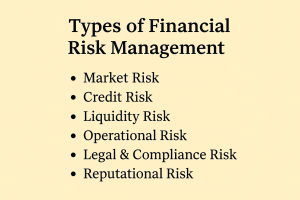
3. Liquidity Risk
Liquidity risk comes up when an organization cannot meet short-term financial requirements due to an inadequacy of cash flow. Understanding what financial risk management is helps businesses in the creation of buffers to absorb liquidity crunches.
4. Operational Risk
Operational risks are associated with internal processes, system failures, or human errors. This will involve fraud, mismanagement, or technology breakdowns. It is an essential part of the types of financial risk management approaches used today.
5. Legal & Compliance Risk
Legal risks arise for a business when non-compliance occurs with regulations, laws, or contractual requirements. Effective management of financial risk makes certain that compliance frameworks are current at all times.
6. Reputational Risk
Any damage to a company’s public image can affect revenue, stock prices, and customer trust. This indicates another area where what is financial risk management becomes vital for brand protection.
Grasping each category helps business entities develop a diversified and layered protection mechanism under the broad area of financial risk management.
Practical Examples of Financial Risk Management
1. Hedging against currency fluctuations
Consider an Indian company exporting goods to the U.S. The exchange rate may dramatically change before the company receives payment, thereby affecting the profit. To avoid such losses, the company enters hedging contracts. This demonstrates the true worth of financial risk management.
2. Investment Portfolio Diversification
Rarely do investors put all their capital in one stock. They diversify into sectors and asset classes so that the impact is minimized when the market turns down. Diversification is a typical example of understanding types of financial risk management.
3. Banks Using Credit Scoring Models
Banks apply various risk assessment tools before sanctioning any loan. This would reduce the probabilities of defaults and hence maintain financial stability. Application of what is financial risk management helps banks to keep their portfolio healthy.
4. Companies Buying Insurance
Insurance against operational risks-like fire, cyber attacks, or breakdown of machinery-is often purchased by organizations. This is another practical application of financial risk management.
5. Stress-Testing Financial Models
Financial institutions run stress tests in order to predict their performance in adverse situations, like recessions. Such tests are an integral part of many types of financial risk management processes. These examples not only show how risk management works but also support the importance of knowing what financial risk management is in today’s economy.
Final Thoughts
By this point, you should have a clear understanding of what financial risk management entails and why it acts as a cornerstone for business and investment planning. Whether through market volatility, credit uncertainty, liquidity issues, or operational failure, risk management helps reduce vulnerabilities and strengthens decision-making over the long term.
From discussing the types of financial risk management, techniques, processes, and the real application in the world, it is clear that financial stability heavily relies on proactive strategies. A modern organization can’t succeed without a strong approach to financial risk management that should align with its goals and future vision.
Frequently Asked Questions


