Can AI Replace Software Engineers in the Future?
As artificial intelligence continues to evolve at a breathtaking pace, it’s transforming every corner of the professional landscape, from healthcare and finance to manufacturing and IT. One of the most debated questions in this transformation is: Will AI replace software engineers? With tools like GitHub Copilot, ChatGPT, and automated code generators now capable of writing entire modules of code, many professionals are wondering whether the traditional role of a software engineer might soon be at risk. Yet, amid this uncertainty lies a tremendous opportunity, a chance for today’s engineers, learners, and aspiring technologists to evolve, upskill, and redefine their careers in the era of intelligent systems.
In a world where artificial intelligence is advancing rapidly, professionals today face uncertainty: will AI replace software engineers, or will it merely reshape the profession? This blog delves into that question. As learners and professionals increasingly consider upskilling, switching careers, or aligning with emerging domains, the concern about AI’s impact on traditional roles gains urgency. Through a balanced, data-driven lens, this article examines how AI and software engineering might coexist, evolve, or conflict, and how you can stay ahead in the changing landscape.
Table Of Content
Can AI Replace Software Engineers?
How Jaro Education Helps You Stay Ahead
Navigating the Future: Human Ingenuity Meets Artificial Intelligence
Frequently Asked Questions
Can AI Replace Software Engineers?
*newsletter.victordibia.com
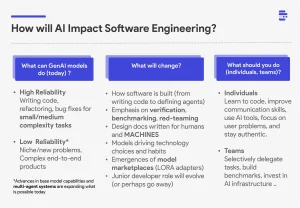
Below are the major dimensions of this question, each shedding light on whether AI will replace software engineers or not. And how we can adapt to the changing landscape.
1. What AI Can and Can’t Do in Software Engineering
Before diving into specifics, it’s essential to understand that AI in software engineering functions best as a collaborative partner, enhancing productivity and accuracy but still relying on human creativity, problem-solving, and decision-making.
| Area | What AI Excels At | Where Humans Still Lead |
| Code generation | Producing boilerplate code, snippets, templates, and documentation | Designing system architecture, ensuring scalability and maintainability |
| Code review | Identifying basic bugs or inefficiencies | Understanding business logic, user impact, and trade-offs |
| Testing | Auto-generating unit or regression tests | Determining meaningful test coverage and edge cases |
| Maintenance | Suggesting refactoring or optimization | Handling legacy systems, strategic migration, and long-term planning |
| Learning new frameworks | Quickly analyzing open-source libraries and syntax | Applying frameworks in complex, real-world business contexts |
AI tools act as accelerators; they improve productivity and efficiency. However, software engineering is not just about writing code. It’s about solving complex problems, understanding business objectives, and collaborating with teams in areas where human intelligence, empathy, and creativity still dominate.
So, while AI may automate some coding tasks, it won’t replace the deep, analytical, and collaborative roles that software engineers perform.
2. Market Demand and Salary Trends
The global demand for software engineers remains robust. Even as AI takes on more coding tasks, it simultaneously creates new roles, such as AI systems engineer, prompt engineer, and AI product developer.
| Experience Level | Typical Salary Range (India) | Career Outlook |
| Entry-level (0–2 years) | ₹3–6 LPA | Roles increasingly combine coding with tool-assisted development |
| Mid-level (3–7 years) | ₹8–15 LPA | Growing demand for AI-integrated development skills |
| Senior (8+ years) | ₹20 LPA+ | Leadership in AI, architecture, and automation strategy |
Globally, software engineers remain among the most sought-after professionals, with opportunities expanding in industries such as healthcare tech, fintech, cybersecurity, and cloud computing.
Rather than declining, demand is shifting toward engineers who can leverage artificial intelligence in software engineering effectively, using it as a partner, not a competitor.
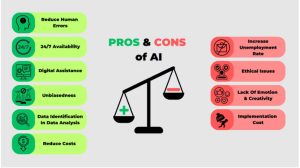
3. Pros and Cons of AI in Software Engineering
*adamfard.com
Advantages:
- Faster Development Cycles: AI helps automate repetitive coding, reducing time-to-market.
- Improved Code Quality: AI-assisted reviews identify bugs and inefficiencies early.
- Democratized Access: Non-technical professionals can build prototypes with AI tools, encouraging innovation.
- Skill Amplification: Engineers can focus on problem-solving, design, and innovation instead of repetitive coding.
Challenges:
- Overdependence on AI: Blind reliance on auto-generated code can introduce unseen flaws.
- Contextual Understanding: AI often lacks the domain-specific judgment needed for critical applications.
- Security and Ethics: Human oversight is essential to ensure fairness, safety, and compliance.
- Job Shifts: Entry-level coding roles may evolve or shrink, demanding reskilling in design, testing, and AI integration.
Thus, will AI replace software engineers entirely? Unlikely. It will reshape their role, making human engineers the directors and supervisors of intelligent coding systems rather than just code writers.
4. Future Roles and Opportunities
As AI becomes integrated across development processes, the future of software engineering looks less like replacement and more like collaboration.
| Emerging Roles | Core Focus |
| AI-assisted Developer | Using generative AI for faster coding and automation |
| Prompt Engineer | Crafting effective AI queries to generate desired outputs |
| AI Systems Architect | Designing large-scale intelligent systems |
| Machine Learning Engineer | Building, training, and maintaining AI models |
| Software Ethics Specialist | Ensuring fairness, security, and compliance in AI-driven codebases |
Professionals who combine technical expertise with creative and strategic thinking will thrive. The future belongs to engineers who understand both software principles and how to work alongside AI systems effectively.
5. Will Software Engineers Be Replaced by AI?
The short answer to the question “Will AI replace software engineers?” is: No, but their roles will evolve significantly.
AI will handle repetitive, pattern-based tasks. However, software engineers will continue to drive creativity, architecture, and innovation areas that demand human reasoning, emotion, and accountability.
The future of software engineering will be hybrid, where AI enhances performance while humans ensure alignment with goals, ethics, and long-term vision.
How Jaro Education Helps You Stay Ahead
Collaborations with Premier Institutions:
Access programs co-developed with IITs, IIMs, and leading global universities.
Expert Faculty:
Learn directly from professors and industry leaders in AI, data science, and software development.
Flexible Learning:
Live + online sessions, weekend classes, and recorded lectures are ideal for working professionals.
Real-World Projects:
Hands-on capstone projects that mirror modern AI and software challenges.
Personalized Counseling:
Get guidance to select the most relevant program based on your career goals.
Whether you’re a software engineer wanting to upgrade to AI roles or a professional from another field aiming to transition into tech, Jaro Education helps you make informed choices.
Program Highlight:
- Duration: 10-11 Months
- Mode: Live Online Teaching by the Faculty of IIT Madras, Hands-on simulation
Frequently Asked Questions
Jaro offers personalized counseling, academic guidance, and access to Jaro Connect, which provides career services, alumni networking, and industry insights.
Unlike generic online courses, Jaro’s programs are exclusive collaborations with IITs, IIMs, and leading universities. Learners benefit from a structured curriculum, expert faculty, and industry-oriented insights.


